A Particular form of Orientalism

In the most recent issue of Boulevard, poet and fiction writer Anis Shivani published an ideological critique of Dave Eggers’s 2012 novel A Hologram for the King. I haven’t read the novel, and so was going to skip the essay, but the author made a few bold statements about the novel right at the top, and I was intrigued. The essay, it turns out, is a smart and accessible critique of the book from a postcolonial perspective. Shivani points out that “In the last few years in America we’ve had white novelists representing Muslims and Arabs more prominently that Muslims or Arabs have in their own writing.”

What we’re seeing is perhaps a particular form of Orientalism, only pitched at a higher, more refined, more politically correct level. The other can’t be demonized, of course–that’s the business of bureaucrats propagating the endless campaign against terror, or unreconstructed neoconservative types–but whereas Eggers may be offering something of a critique of neoliberlism in economic terms, his overall venture in Hologram accords quite well with neoliberlism’s position with respect to countries on the periphery.

For neoliberalism, countries like Saudi Arabia are the subject of particular discourse formations, and I don’t think Eggers deviates too far from this discourse because he too, after all, breathes the same intellectual air.

…I don’t want to suggest that Eggers doesn’t depict Saudis sympathetically–he does–but the kind of sympathy he represents is precisely the problem.

The essay goes on to argue this point, effectively illuminating the ideology behind the novel. “Eggers is to be given credit for taking on big subjects, when the predominant bulk of American literary fiction insists on living in a world of nostalgia and psychosis,” Shivani notes toward the end. But Shivani’s not about to give Eggers a pass on the way he approaches his big subject. Fun, fun, fun.

In the same issue, the essay that did attract my attention from the top, but that I actually couldn’t finish, was Robert Zaller’s Toward the Post-Modern Novel: The Polyphonic Consciousness of György Sebestyén.

The piece’s aim is to re-introduce this Hungarian author to the English-language audience. Sebestyén died in 1990, and though some of his work was translated to English before his death in the few years that followed, it seems he’s largely been forgotten by the English-language public. Zaller contextualizes his novel as post-modern in relationship to modernists Proust, Joyce, and Musil. Other names that appear in the first two pages of the piece are Stendhal, Dostoyevsky, Kafka, Robbe-Grillet, Le Clezio, Gaddis, Pynchon, Wallace, Beckett, Roth, Kundera, Kadare, Nabokov, W.G. Sebald, Celan. That’s a lot of name-dropping. Courtesy of NYRB Press, I’ve actually been very interested in mid-century Hungarian authors. By far, the most interesting of the novelists I’ve read lately was Magda Szabo. Not that I was really expecting to find her name in Zaller’s essay, but her name was fresh enough in my mind to make me aware that Zaller’s list didn’t include a single female author, modern, post-modern, or what. Not even Virginia Woolf. I got so distracted by my own track of thought, I never got to part two of his long-ish essay.

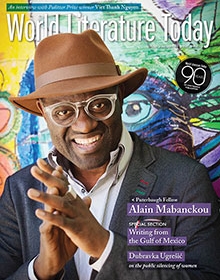
 

World Literature Today, Sept-Oct 2016

sept16_220pxThe current issue of World Literature Today features an essay by Dubravka Ugrešić, translated by Ellen Elias-Bursać, about misogyny and identity that I found meaningful as a reflection on my own writing and identity as a writer. She says,

For years I have been trying to dodge the label “Croatian writer” or “Croatian writer who lives in Amsterdam,” though my life experience has confirmed that this sort of tattoo is almost impossible to remove. Why? Because most people use ethnic coordinates when remembering, classifying, defining, and judging others.

… in Croatia (like, indeed, so many other places), male writers represent their homeland, state, nation, and national literature; their works harmoniously build the national literary canon. Female writers may either profit by or be victimized by such constellations. Mostly they are victimized.

Other highlights from this issue include a feature on Gulf Literature, here represented by several authors from Mexico, the US South, and Cuba. A powerful excerpt from LeAnne Howe’s “Savage Conversations” tells the story of Mary Todd Lincoln being judged insane because she was haunted by an Indian. “And I believe her,” Howe begins. A powerful way to contextualize her work as feminist and post-colonial. The rest of the piece is crazy and brilliant.

The interview with Alain Mabanckou does a great job of introducing this writer by his reading list. I love his project of actively trying to read–and to be influenced by–lit from around the world. He wants to cover all continents, it seems. This is worth skimming for his reading list alone. Some of the African writers he names are Aimé Césaire, Édouard Glissant, René Maran, Mongo Beti, Camara Laye.

In the marvelous World Literature in Review section, a brief mention of a recently translated Natalia Gromova’s Moscow in the 1930 (Trans. Christopher Culver). Go ahead and buy this book. For all interested in twentieth century Russian lit, this is required reading.

Kirstin Valdez Quade’s essay in the New York Times

Kirstin Valdez Quade has had a very unique childhood, and it’s a credit to her art that when she writes about it, I’m instantly there with her, uncomfortable as hell, and reaching, reaching.

When I was 11 and my sister 6, my parents pulled us out of our new Australian school for a six-week-long research trip across the belly of the continent. A year earlier, we had moved from the United States to Canberra, where my dad was doing post-doctorate work in geochemistry at the Australian National University, and now we were setting out to explore this vast new country.

Our four-wheel drive — on loan from the university — was a troop carrier that could, in a pinch, be used to transport prisoners.

Read The Season of the Skulls in the New York Times.

Two Lines: Fall Issue

Two Lines Press has come out with a new anthology of world writing in translation, their Fall 2016 Issue. My favorite piece in this book is the first, “Sea Swell” by Enrique Vila-Matas, translated from Spanish by Margaret Jull Costa. This is how it opens,

I had a friend once. Indeed, at the time, I only had one friend. His name was Andrés and he lived in Paris and, much to his delight, I traveled to that city to see him. The very evening of my arrival, he introduced me to Marguerite Duras, who was a friend of his. Unfortunately, that evening, I had taken two or three amphetamines.

The voice is humorously self-depreciating, yet confident in telling an important story.  The line notes tell me that Vila-Matas specializes in “stories and novels that plays with the interrelation between fiction and reality,” so I’m reading this as roman à clef. Whether or not the author has actually ever met Marguerite Duras really doesn’t matter as much as the question whether this piece is a stand-alone story or a part of a larger narrative. The ending, though not abrupt, leaves me wanting a lot more.

An accompanying story appears on the Press’s website, “Vampire in Love.”  I haven’t yet had a chance to read it, and I’m a little put off by the title, but I hope to get to it soon.

In the printed anthology, another piece that stood out to me, is “Eni Furtado Has Never Stopped Running” by Alicia Kozameh, translated from Spanish by Andrea G. Labinger. A woman has come to the cemetery to clean her father’s remains. The narrator gives us nearly every bone of this man’s body, together with the smell and, ehrm, taste. Contemporary literature seems, at times, peaked on finding limit experiences, taboos to break, and this piece is that. I’m not sure whether I liked it because or in spite of this.

Recent reading

My friend Peg Alford Pursell who runs a luminous reading series, Why There Are Words, in Sausalito, has recently started an independent press. She’s been reading submissions to find the first two books, to publish in the next year. (For those of you with manuscripts: The submission period closes September 15, 2016.) Whatever she chooses, will have to serve as the face of the new press, will be seen as its representative work. Then, hopefully, the second year follows, and the new selection process, that will give us a more rounded understanding of what kind of publisher WTAW Press is. A great press, I suppose, is like a great character: always surprising, always engaging.

Peg recently asked me to contribute to her newsletter a list of books that I’ve been reading. Here’s the write-up on some of my favorites.

Americanah by Chimamanda Ngozi Adichie. If you haven’t read it yet, do. It’s a funny and poignant page-turner about a popular blogger, Ifemelu, who decided to return to Nigeria after many years in the United States. Commentary on racism, colonialism and globalism, culture shock, family dynamics is held together by a sweet and ultimately satisfying love story.

Gabriel: A Poem by Edward Hirsch. This is a book-length poem published a few years after the sudden death of the poet’s adopted son, Gabriel. The tercets of this poem lead a reader through the journey of the young man’s last hours, through his life’s story, through the story of the father’s bereavement. No platitudes apply. This book does not uplift the reader and doesn’t leave her enlightened; the poet doesn’t get a break from his grief; the son’s neurological and mental health issues are portrayed in all their messiness. This book doesn’t make grief interesting—it puts into words what grief is.

Fair Play by Tove Jansson. In Europe (she lived in Helsinki, Finland and wrote in Swedish) Jansson is best known for her comic strip about the Moomin family that started out as a political cartoon and after WWII turned into wildly successful books for children. Fair Play was published when Jansson was seventy-five, and is a collection of stories about the relationship between a comic book author and her partner, a visual artist. Though Jansson was never publicly out as a lesbian, this book provides a fascinating glimpse into her intense creative and personal relationship with artist Tuulikki Pietilä.

In The Price of Water in Finistère by Bodil Malmsten, fifty-five year old author moves from her home in Sweden to Brittany, in France, the Finistère département. Her descriptions of settling in the new place, fixing her house, breaking a garden are intertwined with her memories of growing up in a remote northern village in Sweden. I particularly enjoyed reading about a happy moment in a woman’s life: she has come into her own and is ready to stake her claim in the world. She proceeds with humor and poetry.

Here is another shout-out to My Name is Lucy Barton by Elizabeth Strout. I first heard of this book through this newsletter—thank you, Peg. I read it and I loved it. It was recently nominated for the Man Booker Prize, and I’m rooting for it. It’s a powerful novel about the long-term effects of poverty and violence.

The Door by Magda Szabo. This novel comes to us from Hungary, and is also, in part, autofiction. The author’s relationship with her housekeeper reads as a thriller, in one breath, from the beginning to the horrifying and gruesome end. What makes this book really work is the complexity of characterizations Szabo achieves. The two main women love and care for each other, but somehow in the course of the narrative these feelings turn against them.

The latest review I published in The Common was of Memories by the early twentieth century Russian author Teffi. By the time of the Bolshevik revolution in 1917, Teffi had nearly a dozen books to her name, and new printings of her story collections sold out instantly. With Lenin at the helm of the government, her fame became a liability. Memories opens with Teffi being talked into going on tour to Ukraine, the trip that became her journey out of Russia.

Last but not least, a shout-out to opera. This September, San Francisco Opera is staging Dream of the Red Chamber—based on the 18th Century Chinese novel by Cao Xueqin, adapted to the stage by Davin Henry Hwang of M. Butterfly fame. The novel is an epic series of tragic love triangles and an education about Chinese culture of the era. In the English translation, it runs 2,339 pages long.That’s 2,339 pages of total fascination, people!

Svetlana Boym’s Another Freedom

The word for freedom, eleutheria, is related to the border zone town of Eleutherae between Athens and Thebes, to art and religion, the history of the festival of the Dionysia and the emergence of classical tragedy. Pausanias reports that “the reason why the people of Eleutherae came over was not because they were reduced by war, but because they desired to share Athenian citizenship and hated the Thebans.” They carried with them the wooden statue of Dionysus, who initially was not accepted in Athens. According to the legend, the got from the borderlands became infuriated and brought plague to the city of Athens. This is how the festival of the Dionysia came into being. Subsequently this collective festival opened a space for individual creativity, transforming ritual into theater–a space where political and artistic eleutheria opened dialogues about the boundaries of the polis. Eleutheria is a freedom of the border zone–a freely chosen “immigration” and incorporation of local and foreign gods–that also gives birth to poetry and theater.

From Svetlana Boym’s Another Freedom, Chicago UP, 2010

Marie Houzelle’s Tita

Occitania, a large region of Southern France that includes parts of Spain and Italy, has been for centuries crisscrossed by traders and traveling folk from the far reaches of Europe and Northern Africa. Its ancient language, Occitan or langue d’oc, a close relative of Catalan, was immortalized as early as the 11th Century by troubadours, the traveling poets, serenading chivalry and courtly love. Though annexed gradually in the early modern era by the French kings, the region has preserved many of its ancient customs, the language, cuisine, the tradition of wine making. Born here in the 1950s, Tita, the heroine of Marie Houzelle’s eponymously titled novel, inherits this rich culture at the moment of crisis.

After World War II, life in a small Occitan community is dominated by the Catholic church and the old class structure separating the landed bourgeoisie from the farmers and day-laborers. But the depressed wine business and the growing trend for the young people to seek opportunities in the cities, outside of traditional occupations, threatens to drain the region of all lifeblood. A daughter of a wine-seller and a self-made woman who before marriage owned a beauty salon in Lyon, Tita sees her father’s business suffering from the lack of demand while her mother enjoys playacting a fashionable lifestyle. She must have a crocodile-skin handbag for her birthday; her daughters must have two first communions, the private and the solemn, each accompanied by new outfits and lavish parties. Continue reading “Marie Houzelle’s Tita”