
Love and Hair

I’m delighted to report that my story “Love and Hair” won Willesden Herald’s International short story competition. The award ceremony took place in London this week, and I took home the coveted prize: a large mug and a bottle of campaign. The story appears in an anthology, New Short Stories 9, together with nine other short-listed stories. I’ve been reading the anthology, and I’m so impressed with the competition.

Here’s the snippet from my story. The print anthology is available on Amazon US and Amazon UK.

The stage crew had been drinking since The Wizard of Oz Singalong the night before and now the director, suffering from a sinus infection, was losing her voice, pleading over the phone with actors calling in sick. This was a radical departure from the spirit of fun and camaraderie I’d expected when I volunteered to perform in an amateur production of The Vagina Monologues. During our final run-through just hours before opening night curtain, we were three actors short and had to find substitutes. I’d recruited half a dozen of my friends to buy tickets—and what if any of them actually showed up? The lack of professionalism embarrassed me.

As the rehearsal finally got underway, my phone buzzed. The house manager turned to me and hissed, animal-like, “What’s that?” She’d been getting on my nerves all afternoon, having berated me for bringing a burrito into the theatre and for daring to eat it while she talked to us about emergency exits. I ignored her and looked at my phone.

A text message: “I’m in San Francisco.” My new phone failed to decode the number, but I had a good feeling the text came from this girl Hana, an Israeli who lived in Portland.

“Great,” I texted back, “I’ll see you after the show.”

On the first night I’d met her, Hana put her hand on my shoulder, gripping firmly, and said, “You look so Russian, Yelena. I’d love to seduce you.” Then she toasted me with whiskey and walked away.
A Particular form of Orientalism

In the most recent issue of Boulevard, poet and fiction writer Anis Shivani published an ideological critique of Dave Eggers’s 2012 novel A Hologram for the King. I haven’t read the novel, and so was going to skip the essay, but the author made a few bold statements about the novel right at the top, and I was intrigued. The essay, it turns out, is a smart and accessible critique of the book from a postcolonial perspective. Shivani points out that “In the last few years in America we’ve had white novelists representing Muslims and Arabs more prominently that Muslims or Arabs have in their own writing.”

What we’re seeing is perhaps a particular form of Orientalism, only pitched at a higher, more refined, more politically correct level. The other can’t be demonized, of course–that’s the business of bureaucrats propagating the endless campaign against terror, or unreconstructed neoconservative types–but whereas Eggers may be offering something of a critique of neoliberlism in economic terms, his overall venture in Hologram accords quite well with neoliberlism’s position with respect to countries on the periphery.

For neoliberalism, countries like Saudi Arabia are the subject of particular discourse formations, and I don’t think Eggers deviates too far from this discourse because he too, after all, breathes the same intellectual air.

…I don’t want to suggest that Eggers doesn’t depict Saudis sympathetically–he does–but the kind of sympathy he represents is precisely the problem.

The essay goes on to argue this point, effectively illuminating the ideology behind the novel. “Eggers is to be given credit for taking on big subjects, when the predominant bulk of American literary fiction insists on living in a world of nostalgia and psychosis,” Shivani notes toward the end. But Shivani’s not about to give Eggers a pass on the way he approaches his big subject. Fun, fun, fun.

In the same issue, the essay that did attract my attention from the top, but that I actually couldn’t finish, was Robert Zaller’s Toward the Post-Modern Novel: The Polyphonic Consciousness of György Sebestyén.

The piece’s aim is to re-introduce this Hungarian author to the English-language audience. Sebestyén died in 1990, and though some of his work was translated to English before his death in the few years that followed, it seems he’s largely been forgotten by the English-language public. Zaller contextualizes his novel as post-modern in relationship to modernists Proust, Joyce, and Musil. Other names that appear in the first two pages of the piece are Stendhal, Dostoyevsky, Kafka, Robbe-Grillet, Le Clezio, Gaddis, Pynchon, Wallace, Beckett, Roth, Kundera, Kadare, Nabokov, W.G. Sebald, Celan. That’s a lot of name-dropping. Courtesy of NYRB Press, I’ve actually been very interested in mid-century Hungarian authors. By far, the most interesting of the novelists I’ve read lately was Magda Szabo. Not that I was really expecting to find her name in Zaller’s essay, but her name was fresh enough in my mind to make me aware that Zaller’s list didn’t include a single female author, modern, post-modern, or what. Not even Virginia Woolf. I got so distracted by my own track of thought, I never got to part two of his long-ish essay.


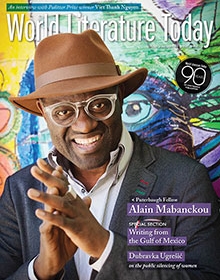
World Literature Today, Sept-Oct 2016

sept16_220pxThe current issue of World Literature Today features an essay by Dubravka Ugrešić, translated by Ellen Elias-Bursać, about misogyny and identity that I found meaningful as a reflection on my own writing and identity as a writer. She says,

For years I have been trying to dodge the label “Croatian writer” or “Croatian writer who lives in Amsterdam,” though my life experience has confirmed that this sort of tattoo is almost impossible to remove. Why? Because most people use ethnic coordinates when remembering, classifying, defining, and judging others.

… in Croatia (like, indeed, so many other places), male writers represent their homeland, state, nation, and national literature; their works harmoniously build the national literary canon. Female writers may either profit by or be victimized by such constellations. Mostly they are victimized.

Other highlights from this issue include a feature on Gulf Literature, here represented by several authors from Mexico, the US South, and Cuba. A powerful excerpt from LeAnne Howe’s “Savage Conversations” tells the story of Mary Todd Lincoln being judged insane because she was haunted by an Indian. “And I believe her,” Howe begins. A powerful way to contextualize her work as feminist and post-colonial. The rest of the piece is crazy and brilliant.

The interview with Alain Mabanckou does a great job of introducing this writer by his reading list. I love his project of actively trying to read–and to be influenced by–lit from around the world. He wants to cover all continents, it seems. This is worth skimming for his reading list alone. Some of the African writers he names are Aimé Césaire, Édouard Glissant, René Maran, Mongo Beti, Camara Laye.

In the marvelous World Literature in Review section, a brief mention of a recently translated Natalia Gromova’s Moscow in the 1930 (Trans. Christopher Culver). Go ahead and buy this book. For all interested in twentieth century Russian lit, this is required reading.