Spring Events

“My son wants to take the streetcar. My daughter doesn’t. She doesn’t want to walk, either.” A new fiction of mine, “A Train is Coming,” appears in the upcoming issue of Mom Egg (MER) Review 23, copy available for purchase as a PDF and in print. If you want to hear me read it out loud on Zoom, register for the issue release party (free), where I’m delighted to share the stage with my friend, poet Olga Livshin, among others.

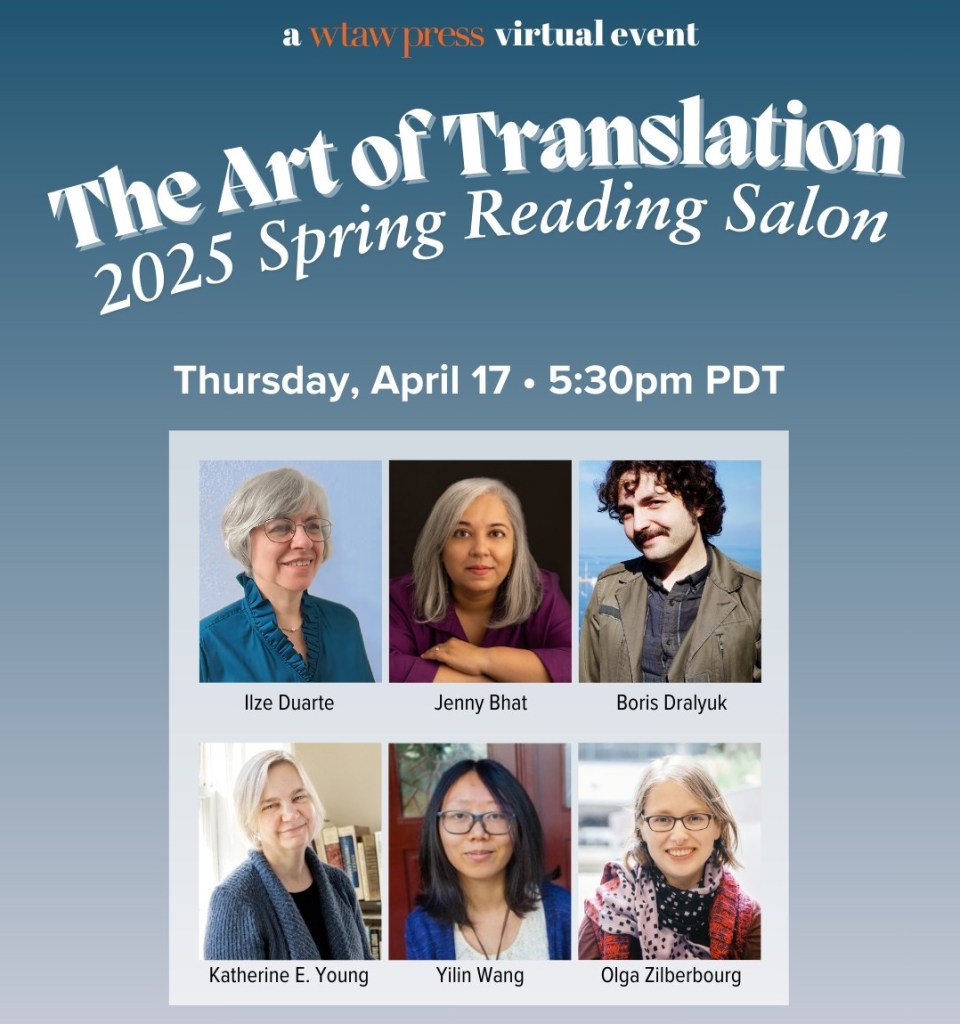
If you can only make it to one Zoom-based Olga Z event this month, I strongly encourage you to come to the translation salon I’ll be MCing on April 17th. Coorganized by translator Ilze Duarte and hosted by WTAW Press (that published my collection), this event will bring to you some of the leading literary translators of the English-speaking world, representing writers from Brazil, India, Ukraine, Azerbaijan, and China. Readers of this newsletter will recognize the names of Boris Dralyuk, who translates Andrey Kurkov, and Katherine E. Young, the translator of Akram Aylisli. It so happens that all of the translators on this reading are also writers and poets themselves, and I only wish I had the time to interview them about how they combine their own writing with their translation projects. One thing for sure, they’re masters of the English letters, opening worlds into other languages and cultures for us. Register (it’s a virtual, Zoom-based event)! This will be fun.
Bay Area locals: I have one more event to invite you to. On May 4, at 1 pm, I’ll be taking a part in a brand new Jewish Arts & Bookfest, being organized at the UC Berkeley’s Magnes collection, “one of the world’s preeminent Jewish museums” (I’m just learning about it too). I’m moderating a panel we called Between War and Peace, on the role of Russian literature in the work of Soviet-born Jewish American writers, featuring Margarita Meklina, Tatyana Sundeyeva, and Sasha Vasilyuk. How did we get from worshipping Pushkin, Akhmatova, and Bulgakov to writing about Soviet Jewish–and often female–experiences? How do the structures and ideas of Russian and Soviet lit continue to affect our own storytelling? How does the popularity of Russian lit in the US intersect with our USSR-formed experiences of it, and what do we do with the image of a “Russian writer” as a bearded white (and ethnically Russian) man? Following my conversation with Marat Grinberg, I have ever more questions. Please join me.

And to continue the theme of Soviet-born writers, I’m leaving you with the recording from the event that took place in Los Angeles in March, a reading by this amazing group of writers born in the USSR, and translators working with the post/Soviet experience. Thank you to Olga Livshin for capturing and editing this video. We called this event Diaspora Writers Against War, and we’re continuing to do what we can to raise funds in support of Ukraine. Please donate to Ukraine TrustChain.

LIKE WATER gets a review in LARB, shared with Olga Livshin’s poetry collection “A Life Replaced”

I’m delighted and grateful to Linda Kinstler and Los Angeles Review of Books for reviewing my book in a thoughtful piece that places it side by side with the book by my comrade and compatriot Olga Livshin.

What should one tell one’s children of a former life? How much should be passed down? How much can be? These questions also animate Olga Zilberbourg’s new book of short fiction, Like Water and Other Stories, her first collection published in the United States. …

One of Zilberbourg’s heroines, newly graduated from college and desiring to learn more about her heritage, goes to live with an elderly Russian woman in a nearby town. When that experience does not suffice, she goes to St. Petersburg, where she catches the flu, gets groped, and feels alienated and stonewalled by the city’s bureaucracy. “I was back in the United States within a month,” our heroine admits. She discovers that the city of her parents owes her nothing, that it is not required to open itself up to those who were deflected from its path.

https://lareviewofbooks.org/article/deflected-by-this-bitter-era-on-olga-livshins-a-life-replaced-and-olga-zilberbourgs-like-water-and-other-stories/

Rochester, New York: Two Olgas and One Genrikh: Russian Poems, Stories, & Shirts

When: Saturday, November 9, 2019 at 7 PM – 10 PM EST
Where: Java’s Cafe, 16 Gibbs St, Rochester, New York 14604

Join us for a lively evening of stories, poems, and performance art by nonconformist writers from the former Soviet Union, in English.

Olga Livshin‘s book A LIFE REPLACED braids together poems on immigration in America with translations from Anna Akhmatova and our contemporary Vladimir Gandelsman, winner of Russia’s highest award for poetry, the Moscow Reckoning. Many poems are responses to these two voices; some are stand-alone works. Maggie Smith comments: “Livshin, who immigrated to the US from Russia as a child, acknowledges the two Americas she knows firsthand: the one that fears and demonizes, and the one that welcomes. A LIFE REPLACED is astonishingly beautiful, intelligent, and important.”

A graduate of Rochester Institute of Technology, Olga Zilberbourg will introduce her English-language short story collection LIKE WATER AND OTHER STORIES. “The thread connecting these tales,” Anna Kasradze writes for The Moscow Times (ed. Michele Berdy), “is each protagonist’s attempt to come to terms with an identity that is always in flux, transitioning between various contexts such as emigration, motherhood, partnership, and employment.” Olga is the author of three Russian-language books (the latest of which “Хлоп-страна,” Издательство Время, 2016). She has published fiction and essays in Alaska Quarterly Review, Scoundrel Time, Narrative Magazine, Lit Hub, Electric Literature, the San Francisco Chronicle, and elsewhere. She co-moderates the San Francisco Writers Workshop.

Opening for the two Olgas is a poetry performance by translator Dmitri Manin. Avant-garde sonnets by Genrikh Sapgir will be presented on shirts, worn by both Olgas and Dmitri. Sapgir (1928-1999), a hugely acclaimed poet in Russia, first presented his philosophical and funny Sonnets on Shirts–on actual men’s shirts–in 1975. His performance made a sensation amidst an atmosphere of official, staid, highly traditional, print-only Soviet literature. Manin revives his work and re-enacts it in English, using contemporary bodies and presences to channel Sapgir.

Java’s–a ten-minute walk or three-minute Lyft drive from the Floreano Convention Center–will have food and drink for us to regale us into the night with literature and pleasure.