Spring Events

“My son wants to take the streetcar. My daughter doesn’t. She doesn’t want to walk, either.” A new fiction of mine, “A Train is Coming,” appears in the upcoming issue of Mom Egg (MER) Review 23, copy available for purchase as a PDF and in print. If you want to hear me read it out loud on Zoom, register for the issue release party (free), where I’m delighted to share the stage with my friend, poet Olga Livshin, among others.

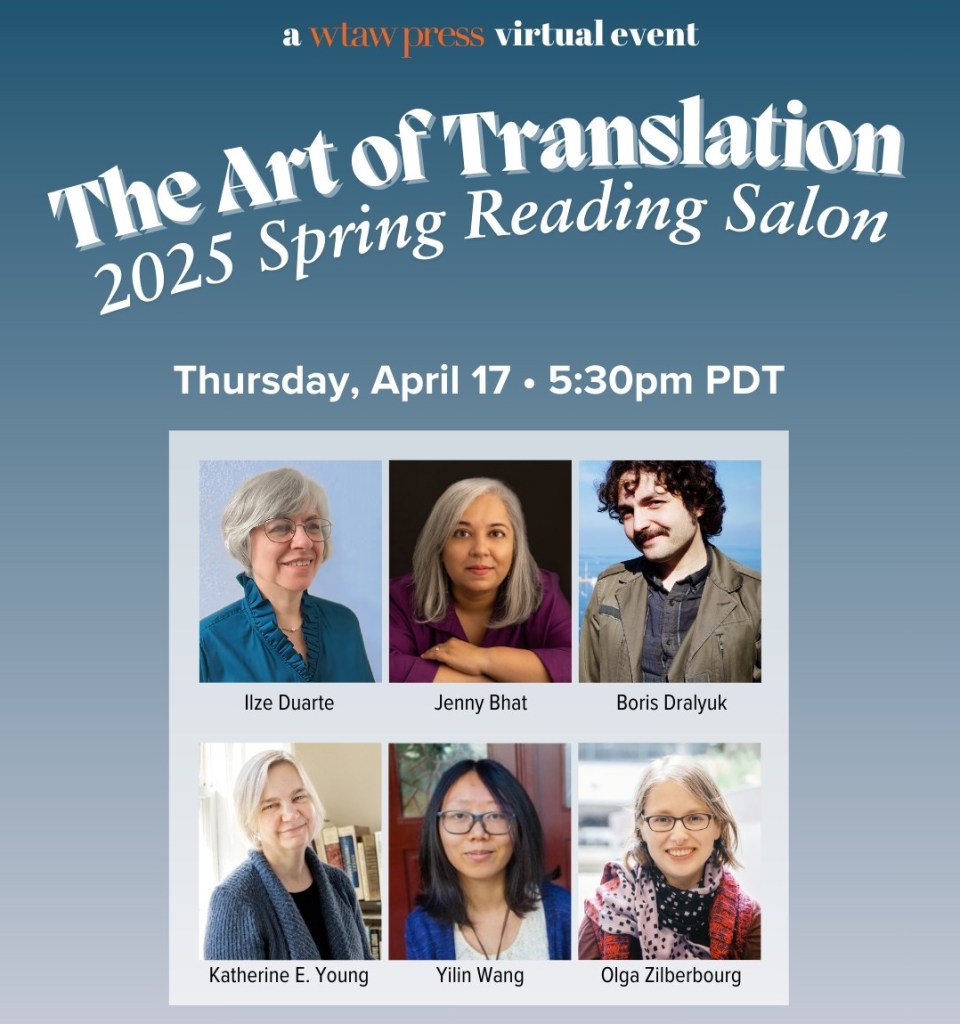
If you can only make it to one Zoom-based Olga Z event this month, I strongly encourage you to come to the translation salon I’ll be MCing on April 17th. Coorganized by translator Ilze Duarte and hosted by WTAW Press (that published my collection), this event will bring to you some of the leading literary translators of the English-speaking world, representing writers from Brazil, India, Ukraine, Azerbaijan, and China. Readers of this newsletter will recognize the names of Boris Dralyuk, who translates Andrey Kurkov, and Katherine E. Young, the translator of Akram Aylisli. It so happens that all of the translators on this reading are also writers and poets themselves, and I only wish I had the time to interview them about how they combine their own writing with their translation projects. One thing for sure, they’re masters of the English letters, opening worlds into other languages and cultures for us. Register (it’s a virtual, Zoom-based event)! This will be fun.
Bay Area locals: I have one more event to invite you to. On May 4, at 1 pm, I’ll be taking a part in a brand new Jewish Arts & Bookfest, being organized at the UC Berkeley’s Magnes collection, “one of the world’s preeminent Jewish museums” (I’m just learning about it too). I’m moderating a panel we called Between War and Peace, on the role of Russian literature in the work of Soviet-born Jewish American writers, featuring Margarita Meklina, Tatyana Sundeyeva, and Sasha Vasilyuk. How did we get from worshipping Pushkin, Akhmatova, and Bulgakov to writing about Soviet Jewish–and often female–experiences? How do the structures and ideas of Russian and Soviet lit continue to affect our own storytelling? How does the popularity of Russian lit in the US intersect with our USSR-formed experiences of it, and what do we do with the image of a “Russian writer” as a bearded white (and ethnically Russian) man? Following my conversation with Marat Grinberg, I have ever more questions. Please join me.

And to continue the theme of Soviet-born writers, I’m leaving you with the recording from the event that took place in Los Angeles in March, a reading by this amazing group of writers born in the USSR, and translators working with the post/Soviet experience. Thank you to Olga Livshin for capturing and editing this video. We called this event Diaspora Writers Against War, and we’re continuing to do what we can to raise funds in support of Ukraine. Please donate to Ukraine TrustChain.

Los Angeles, Zoom, and new publications

I’m delighted to invite you to a one of a kind event happening in Los Angeles on March 28: a reading at the Wende Museum by eighteen writers and translators from the former USSR. We’re coming together to share our work, to get to know each other, and also to eat Ukrainian food (a Ukrainian food truck is expected!) and to support Ukraine.

Register on Eventbrite and if you can’t come, please share this with your friends in LA. Irina Reyn will be there! Katya Apekina! Kristina Gorcheva-Newberry! Our star translators and poets! Did I mention eighteen readers? Each of them, a star.

Expect humor; tales and poems of sex, identity crises, parenting, cultural intersections, immigration, and war. The Wende Museum is dedicated to art and artifacts from the Cold War era, and they are currently running an exhibit called “Undercurrents II: Archives and the Making of Soviet Jewish Identity,” which aligns so closely to what many of us write about. The museum kindly agreed to stay open late for us, until 6 pm, and we’re encouraging people to get there early so that they can tour the exhibit. So: register!

For friends who can’t make it to LA, I have a Zoom event this coming Monday, March 17, 7-8 pm Pacific. Together with writers Jen Siraganian, former Poet Laureate of Los Gatos, and Christin Rice, author of The ABC’s of Pandemic Parenting (Permutation Press), we will be reflecting on the 5th anniversary of the pandemic lockdown. The lockdown has changed our lives in ways that we still feel today. I find it useful to recall the first day, week, month of it, and so I plan to read from my diary–the notes that I managed to capture in the midst of the insanity. To tune in, register here: https://us06web.zoom.us/meeting/register/M-q9F0MfRimjwisnh0uaLQ

I published two new creative pieces in the past month:

  • “Where does your motherland begin? Does it begin with a picture in a primer, with treasured friends who live down the street? With your mother’s song?”

    Radio Baltica, an Essay, about the teenage experience of growing up during my country’s collapse–it’s all about the music of the era and, of course, The Beatles. Thanks to Tint Journal based in Graz, Austria for publishing this piece. I recorded an audio track, so you can hear me reading this essay out loud. Also included is a link to a Spotify playlist where I collected most of the songs I reference. I limited myself to only one Beatles tunes, to be polite, I guess. Alla Pugacheva is here to enchant!
  • “A seven-year-old girl falls in love with a book and tells herself, I want to read every book in the world.”

    New story: “A Woman of Learning,” in Weavers Literary Review. No link here because this mag is print only for now. I have a couple of copies, so let me know if you want one — or feel free to order and support the publishers. The magazine by Moazzam Sheikh and Amna Ali focuses on South Asian American writing, and they have a very strong curatorial vision. I’m honored to have my story included, especially given that my geographies aren’t an immediate match.

I’m taking a break from book reviewing at the moment; that being said, I want to point out two book-related pieces I wrote:

  • To accompany my recent review of Avtodya Panaeva’s The Talnikov Family, I interviewed the translator Fiona Bell as well as Panaeva scholar Margarita Vaysman. To learn more about an incredible 19th century Russian female writer, a woman who helped run a most influential literary magazine, do read this Q&A: Narrating a Violent Childhood on Punctured Lines–here are so many insights!
  • I never miss a chance to gush about a favorite writer. This time, the question “what are you reading now?” from The Common arrived just as I was finishing Bohumil Hrabal’s I Served the King of England.