Stories on Stage

I’m delighted to announce that on Sunday, February 8, 2026 my work will be featured in a reading in Davis, CA called Stories on Stage. A professional actor Eileen Hoang will perform my story “Doctor Sveta” from LIKE WATER AND OTHER STORIES.
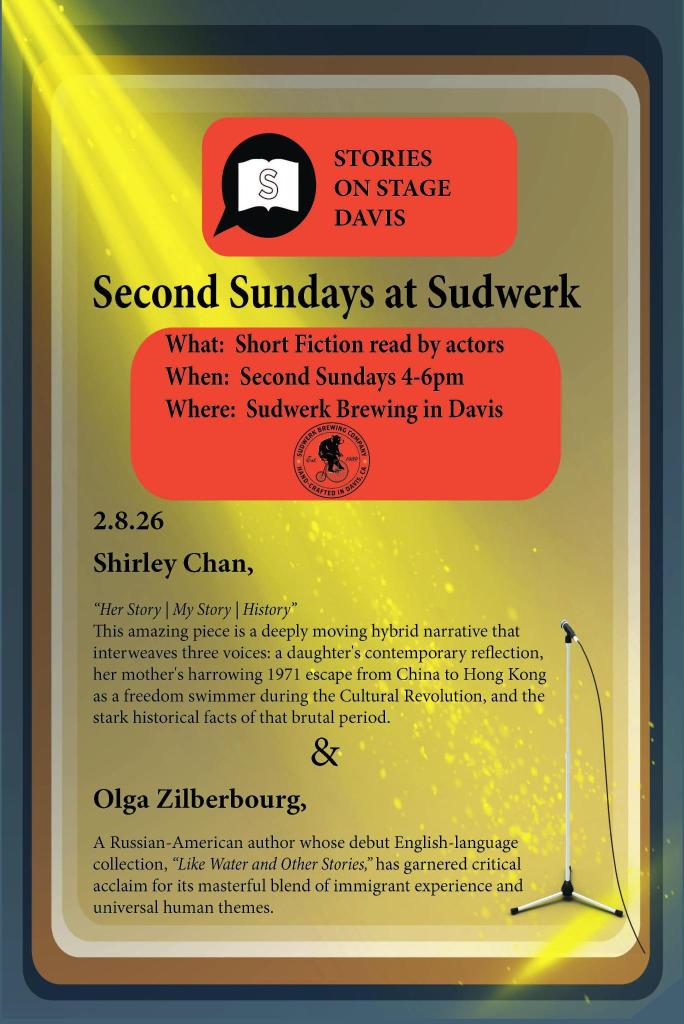
The event starts at 4 pm at Sudwerk Brewing Company in Davis, CA. I can’t wait to see how Eileen might interpret my story “Doctor Sveta,” a historical fiction set during the Cuban Missile Crisis. Huge thanks to organizer, author Jeri Howitt, for putting this together, to the whole team behind the event, and to writer Karolina Letunova for recommending my book.

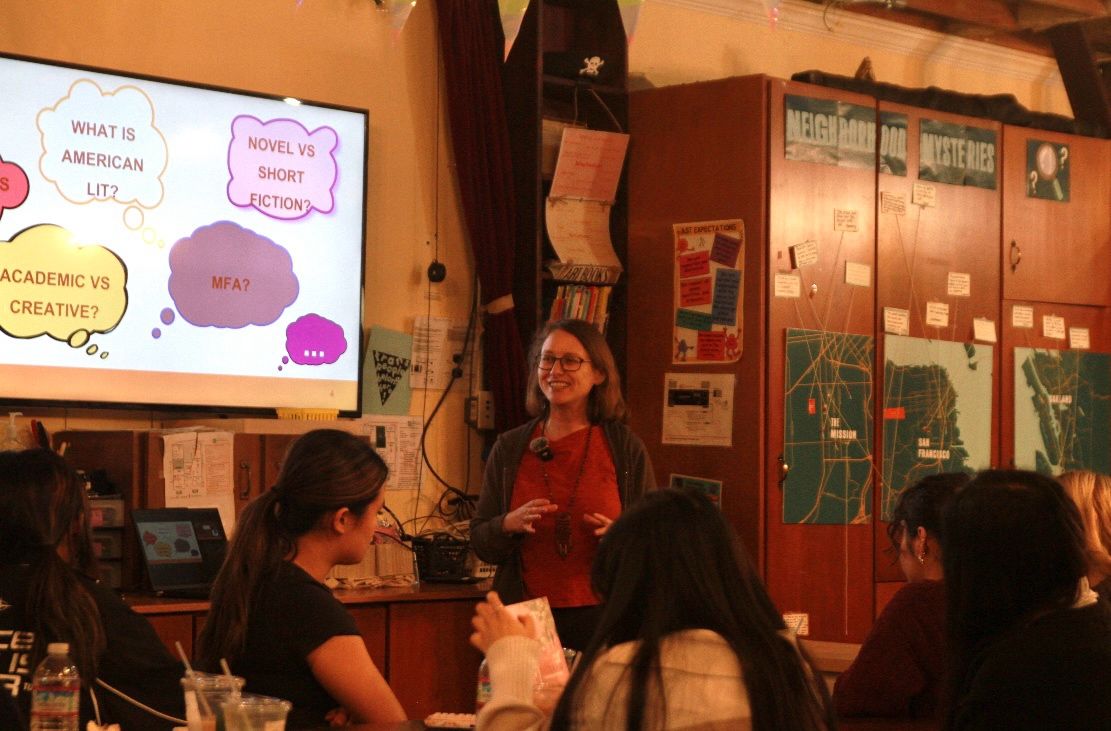
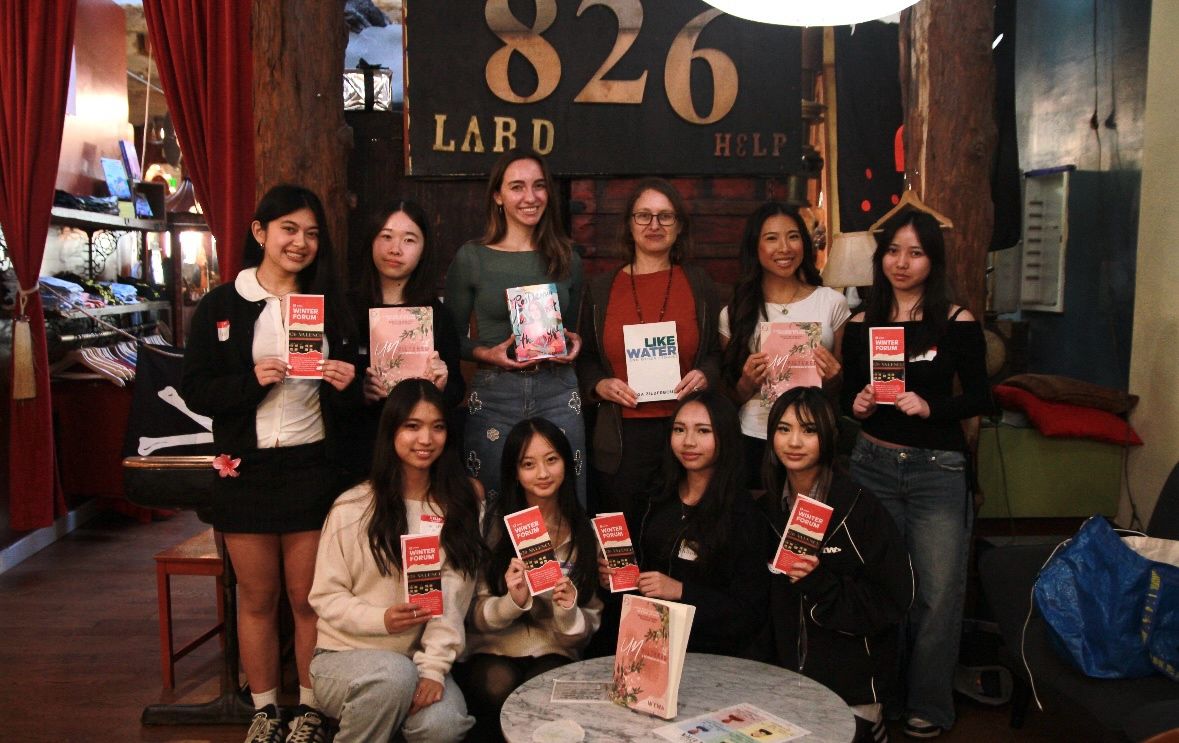
This weekend, I spent an afternoon with a group of about thirty high school students who identify as writers. They banded together to organize Women’s Youth Writing Association (WYWA) with chapters in four local high schools and invited me and Leyla Brittan to give a talk about our writing and writing careers. The participants asked savvy questions about building characters, addressing hyphenated identities on the page, overcoming blocks, finding submissions opportunities, and experimenting with genres. In the face of ever-increasing violence and political instability in the country and in the world, I found this event particularly nourishing. These youths are so talented and motivated!
I have three more links for you today.

  • I reviewed a collection Stories from the Edge of the Sea by a Vietnamese-American writer Andrew Lam for The Common. I’m a big fan of Andrew’s work, and I argue in the essay that he really expands and complicates our ideas of what a short story can be. Also, soup.

  • I reviewed a novel The Disappearing Act by a Russian author in exile, Maria Stepanova, translated by her long-term collaborator, poet Sasha Dugdale for On the Seawall. Writing this piece, I made up a pseudo-psychological term “the beast anxiety” to describe the state of mind of Stepanova’s protagonist. Then, I immediately diagnosed myself with the symptoms.

  • On Punctured Lines this month, read an excerpt from Nadezhda in the Dark, a novel written in verse by Ukrainian-French-American writer Yelena Moskovich. My tagline for this book: The Iliad for post-Soviet Jewish dykes. It’s wild.

To Lit Crawl and Beyond!

Dear friends,

As many of you know, October is Litquake month in San Francisco — our annual literary festival is already underway, with many entertaining, educational, and inspiring events. On October 25 (Saturday), the festival ends with Lit Crawl — a literary pub crawl through the Mission neighborhood.

I’m participating in two events. In Phase 1, from 5-6 pm, find me at Ruth’s Table (3160 21st St), with my fellow immigrant writers from the former USSR. This year, our theme is “Owning Fear, Reaching for Freedom.” We’re reflecting on how our community experience of living under a totalitarian regime has prepared us for the current political moment. And though the theme is as grim as the times, I promise you that the event won’t be. Events with this group of writers and translators are a wonderful occasion to celebrate community and each other’s work. We’re here to support and encourage each other to tell more stories. Too much has been silenced and swept under the rug. We’re trying to bring it all out in the open. It’s a joyous occasion!

A flyer displaying ten author's photos alongside  three quarters perimeter. In the center left, in black, title of the event:
OWNING FEAR, REACHING FOR FREEDOM: POST-SOVIET WRITERS AND TRANSLATORS SPEAK OUT
on the right, in red: LIT CRAWL SAN FRANCISCO
Below, in Blue:
Sat OCTOBER 25TH 5-6 PM
AT RUTH'S TABLE
2160 21st Street
Sponsored by California Humanities and Ruth's Table

Then, for Phase 2, from 6:30 to 7:30 pm, I head to Noisebridge (272 Capp Street), where I will continue to celebrate my writers group. Every Tuesday night, we gather together to read each other our story drafts and to give and receive feedback on our work. This is how we learn to build stronger, more clear and nuanced, stories.

During this event, five of our amazing writers will share their work and tell us about how they’ve revised it after receiving feedback. Then, we’ll ask our audience to critique a story. Guaranteed laughs! (And also maybe it will make revision more approachable to people.)

An image of a blackboard with a stack of yellow pencils in the foreground. Text in yellow and white reads: 
San Francisco Writers Workshop Presents
Five writers read their stories and share the feedback that made them great.
Then YOU get to critique a juicy story, Live!
Below:
Author's portraits with signatures:
Beverly Parayno
Peng Ngin
Tim Sullivan
Jo Beckett-King
Tony Tepper

Below: We've Got Notes for You!
October 25, 2025
Lit Crawl, Phase II, 6:30 pm
Noisebridge, 272 Capp Street

Looking beyond Litquake, on Saturday, November 8, at 6 pm, I will be reading at Telegraph Hill Books alongside my friend Bart Schneider, who has just published his novel GIACOMETTI’S LAST RIDE, about the final romance of a famous Swiss sculptor, Alberto Giacometti. It’s a gorgeously produced book with illustrations by a well-known Sonoma-based artist, Chester Arnold. Bart will introduce the novel, and I will read some of my new work, and then we can talk about books and hang out. Join us!

In other news, my translations from the work of Olga Bragina have received two recent honors.
* Editors of ANMLY nominated the poems they published for a Pushcart Prize.
* One of the poems published by Consequence, has been chosen to appear in Best Literary Translations 2026 anthology, forthcoming from Deep Vellum Press. So delighted! Olga Bragina’s work deserves more recognition.

This summer, Yelena Furman and I have been able to add several publications to Punctured Lines, our feminist blog on post-Soviet and diaspora literature. We pride ourselves in amplifying work by writers from underrepresented groups in our literary space. Dive in:
* We Have to Go Back: Speculative Fiction, Nostalgia, and the Ghosts of Bookshelves Past, Guest Essay by Kristina Ten
* Queering Peripheries: Lara Vapnyar’s “Lydia’s Grove”: Soviet-Born: The Afterlives of Migration in Jewish American Fiction by Karolina Krasuska
* Seven Forty: Memoirs of a Jewish District Attorney from Soviet Ukraine by Mikhail Goldis, translated, edited, and with an Introduction by Marat Grinberg
* Graphic Novels and Memoirs of Soviet Trauma

(Apologies for the TOY STORY reference in my subject line. It’s stuck in my brain and won’t go away.)

With appreciation for you all,

Olga

Sebastopol, Sevastopol

My next event is taking me to Sebastopol, California — a small town north of San Francisco, famous for its apple harvest. My friend, writer Tania Malik, invited me to participate on a panel in Sebastopol’s Lit Crawl this coming Saturday, May 17. I hope to see some of you there!

Built on the land first inhabited by the Coast Miwok and Pomo peoples, Sebastopol apparently got its current name in an 1854 gunfight between two gold diggers, one of whom, a man named Hibbs, barricaded himself inside a general store.”Hibbs’s Sebastopol!” cried the onlookers steeped in the international news of the day. They were referring to the siege of Sebastopol–an episode of the Crimean war–vividly described for the later generations by Lev Tolstoy in The Sevastopol Sketches, Alfred Tennyson, and others.

I, too, have a story that’s partially set in Sevastopol (today, we transliterate the Greek-inspired Russian name of the Crimean town most often with a “v”). In “The Green Light of Dawn,” first published by Epiphany Magazine in 2015, a young woman treks alone on the coast of Crimea, Ukraine to mourn a relationship–a relationship with a man who died, a relationship with her country that ceased to be. I will read the beginning of this story for this event, centered around the idea of “the road.”

My thoughts remain with Ukraine these days. I’m grateful to the editors of ANMLY, a literary magazine interested in experimental international literature, for publishing five more of my translations from the work of the Kyiv-based poet Olga Bragina. Olga wrote these poems in 2023, a year after Russia’s full-scale invasion of Ukraine, and I only wish they could be less relevant today. Russia is continuing its near daily bombings of the civilian population in Ukraine. Please continue donating to relief efforts if you can.

Earlier this month, World Literature Today published my prose translation of a story by Vsevold Garshin that I called “A Captive Palm.” First written in 1879, the story felt contemporary in its personification of tropical plants languishing in a hostile environment of an imperial botanical garden. As I write in the accompanying essay, I was inspired to translate this story by a set of coincidences and also because I’m fascinated with the longevity of plants and ideas—our contemporary dilemma of how to ethically and sustainably build a future in a world shaped by brutal colonial conquests rhymes with the revolutionary thoughts Garshin is attributing to his palm tree.

Thank you all for reading, staying in touch, and coming out to literary events! In the future, I hope to do more Zoom-based events for people outside of the Bay area. Here’s a YouTube recording from a Mom Egg Review (MER) issue release party a few weeks ago, featuring a great many wonderful poets and a few of us, fiction writers. I read the opening of my story “The Train is Coming.”

Recent Publications and a Submissions Opportunity

Friends, one day when we’re all old and gray, please remember to ask me what it takes for a Soviet-born Russian speaker to establish herself not only as a writer of English, but also as a translator into English.

Let me just say that I’m exorbitantly proud of myself for publishing my translations in two more US-based literary magazines. I’m so grateful to the Kyiv-based poet Olga Bragina for trusting me with her work and to the editors of the magazines for seeing what I saw in Olga’s poetry. It is so relatable and so heartbreaking.

Here are the links:

Two poems by Olga Bragina in World Literature Today

Three poems by Olga Bragina in Consequence Forum

Those of you who are writers might be interested to know that WTAW Press has asked me to be one of the jurors for their second annual Kevin McIlvoy Book Prize. If you have an unpublished prose manuscript (novels, memoirs, narrative nonfiction, essay and story collections, and hybrid works), the submissions are open until December 31, 2024. Please submit — I’d love to read your work!

As many of you know, WTAW Press published my collection LIKE WATER AND OTHER STORIES. This book turned 5 years old in September — and it’s not too late to buy it, read, and review on Goodreads and Amazon. All comments are always appreciated. Historically speaking, I haven’t always taken criticism well, but you know, I’m learning, and it’s good for me!

Three more links to this month’s publications:

My review of Shahzoda Samarqandi’s delightfully complex novel Mothersland, written originally in Persian and Tajik and translated to English by Shelley Fairweather-Vega from Russian by Youltan Sadykova. To write this review, I had to study up on the history of Soviet cotton production and the Aral Sea disaster.

On Punctured Lines, the blog that I co-run with Yelena Furman, we had two new pieces this month. First, my Q&A with Sasha Vasilyuk, whose novel about a Soviet WWII soldier with a secret Your Presence is Mandatory I highly recommend. Second, Yelena’s Q&A with Michele A. Berdy, a translator and editor extraordinaire who moved from US to the USSR in the 1970s. Wow, does she have stories to tell!

Pre-order my book!

My book, LIKE WATER AND OTHER STORIES, is now available for pre-order. You can buy it through my publisher’s website by clicking here, or find it on Amazon. The publisher is now running a pre-order discount. The book will be shipped out close to its publication date, which is September 5, 2019.

Pre-ordering the book is an important part of the publishing process that helps to build enthusiasm for the work among all the parties involved, from publisher to book reviewers and the reading public. More specifically, it gives the publisher the idea of how many books to actually print. If you want to support an author, pre-ordering a book (and later writing a review on Amazon or Goodreads or anywhere else) is one of the best ways to do that.

Thank you!

Like Water & Other Stories

I’m delighted to announce my first collection of stories in English, Like Water and Other Stories, will appear later this year from WTAW Press. This news is all the more gratifying because I’ve been a fan and a supporter of this press from their beginning a few years ago, and have loved every book they have put out so far. Check out their website, and here’s the announcement.

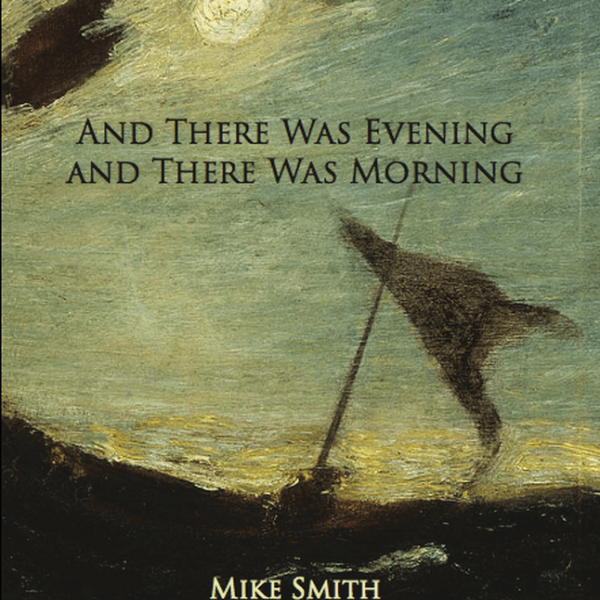
Mike Smith’s And There Was Evening, and There Was Morning

Last year, when I participated, in a small way, with the launch of WTAW Press, I got a chance to read the manuscripts in draft form. This month, holding the two published books in my hand was a strange experience: an excitement coupled with worry, How will they hold up? Will the binding solidify the beauty I had glimpsed in the original writing? Will it bring forward the flaws?

Mike Smith’s book, And There Was Evening, and There Was Morning is a memoir of originalterrible loss: the author’s first wife dies of cancer shortly after the birth of their second child. The book is a collection of essays, structured in such a way that in each piece, in each chapter, we return to this tragedy, over and over again. Fifteen times over we are with Mike and the kids, Virgina and Langston, losing Emily. Other sad, scary, happy, and funny things happen in the book. Mike meets his second wife, they marry and move together to a new town in a new state. His stepdaughter, coincidentally also named Emily, goes through a bout with cancer. But oh boy oh boy. Turn the page, and there’s his beloved Emily, dying again.

Difficult reading? No, not at all. It’s a love story. The book reads like a love poem, on a single gulp of breath. Mike’s tendency to introspection, his openness to Emily and her world and the desire to continue his engagement with her interests and concerns, his ability to converse with her work after her death, is so endearing that from the very first sentences I want to know Mike, I want to spend time with him, I find in myself the resources to stay with him through his grief and to go there, into the hospital room, to be with Emily, in her final months, weeks, and days, over and over again. Emily Arndt was a scholar and I find it a solace that a book that she wrote, a revised version of her dissertation, has been published and can be found out there.

I’ll quote the first sentences from Mike Smith’s memoir, to give a sense of its rhythm and what I mean about it being a love story:

My first wife Emily and I were married for ten years. We met when she walked into the small bookstore where I worked and applied for a job. The manager must have hired her that very afternoon because we shared the following Saturday evening and Sunday morning turnaround shifts. It was fitting that we grew to know one another surrounded by books.

Thank you Peg Alford Pursell and WTAW Press for publishing this. Thank you, Mike, for sharing this story. Thank you also for all of your wonderful insight into story and character and the willingness to push and push on a thread of thought.

The Catography of Others

Catherine McNamara is a uniquely gifted writer, able to translate her amazing travel and life experiences into thought-provoking fiction. I’ve read some of Catherine’s work, and I’m delighted to welcome her upcoming book, The Cartography of Others. It’s being crowdfunded by a UK-based press, Unbound. This promises to be a super cool campaign with some awesome pledges — how about an opera date in Verona?

The Cartography of Others is a collection of twenty stories that take place from fumy Accra to the Italian Dolomites, from suburban Sydney to high-rise Hong Kong. Lives are mapped, unpicked, crafted, overturned. Each story inhabits a location that becomes as vital as the characters themselves, men and women who are often far from home, immersed in unfamiliar cultures, estranged from those they hold dear. Love is panicked, worn, tested.

There’s a cool book video, too.

https://unbound.com/books/the-cartography-of-others