Thank you so much to those of you who have been able to participate in my events in the past month. Lit Crawl was a huge success and I have really enjoyed introducing books of my writer friends to others in the bookish community.
I have one more event this holiday season to invite people in the Bay Area to. On Tuesday, December 9, come to The Sycamore (2140 Mission Street) to celebrate my friend Sasha Vasilyuk’s paperback release of her award-winning novel YOUR PRESENCE IS MANDATORY (such a good title — I just had to use it as the subject of this message).
This novel tells a story that’s very personal to me. Sasha based the book on her grandfather’s experience of being a Soviet Jewish prisoner of war in a Nazi camp. He managed to escape, and then had to hide the fact of his imprisonment from the Soviet authorities in order to avoid the Gulag. This secret came to bear on the rest of his life — and it’s an experience that my grandfather Isaac also shared. (I wrote about my grandfather in this essay for Narrative Magazine.)
Sasha is a great reader and organizer, and this event is bound to be great. Come if you can!
In other publishing news, a story of mine called “Yes” was published in an anthology Immigrant in the City by the London Group of Multilingual Writers, led by Darya Protopopova. Stories in this book alternate between Russian and English, and include writing by my friends Maragarita Meklina and Vlada Teper, as well as work by other established and recent immigrant writers from the former USSR. Many stories address Russia’s ongoing, brutal war against Ukraine and political persecution. My contribution is an older, humorous piece about a recently divorced woman trying to be open to advances of an admirer, whose attempt to woo her with high culture (Pushkin) fails miserably.
Here in San Francisco, the rainy season has officially begun with the first mild and fairly warm storms of the season. Who knows what new cataclysms it might bring? As my friend Gary Pendler writes in his essay “The Bike, the Branch, and the Tick”(*), after a poplar tree branch bizarrely dropped on him in Paris, we have to be prepared that “climate change might also show up in the lives of us ordinary folk and in a myriad of day-to-day incidents.”
The best place to hide from falling branches is, to my mind, a bookstore. And, speaking of Paris, I’ve been spending a lot of time there in my imagination as I’m reading my friend Bart Schneider’s book GIACOMETTI’S LAST RIDE. Giacometti, born in Switzerland, worked in Paris, and this is where Bart’s novel is set. Bart brings to life this consummate artist, in all of his human complexities and vulnerabilities. It’s a thrilling read!
Giacometti, of course, is much beloved all across Europe and the US. But when Bart first brought pages of his manuscript to the workshop that I was a part of, I had been clueless. Bart’s chapters were my first introduction to Giacometti’s legacy. Giacometti, it turns out, was one of those modernist artists who was ideologically unacceptable to the USSR, and so censored there out of existence. The first showing of his work in Russia took place in 2007. Digging deeper, I discovered this wonderful piece above by emigre artist Leonid Sokov (1987), that showcases the clash of cultures: The Meeting of Two Sculptures: Lenin and Giacometti.
In many ways Giacometti’s art, showcasing the fragility of an individual, remains political in today’s world. I’m excited to be able to talk about all this and more with Bart, who will be presenting his novel on November 8, 6:30 pm, at Telegraph Hill Books in San Francisco. I hope you can come!
I’ll also be reading from a longer essay of mine “The Richest Kid in the World” (*) that dramatizes the end of censorship in the Soviet Union.
In the spirit of continuing to unpack modernity through the post-Soviet lens while building community, I am hosting two more events this November.
1) I’m absolutely thrilled that Hamid Ismailov and Shelley Fairweather-Vega will be doing an event in San Francisco for their book WE COMPUTERS, A Ghazal Novel (Yale University Press). This book is a National Book Award finalist–the first book from Central Asia to be a finalist.
Exiled from Uzbekistan (where his books are banned), Ismailov lives in the UK. He writes in at least three languages: Uzbek, Russian, and English, and Fairweather-Vega can translate him directly from Uzbek, without going through Russian. A previous novel of Ismailov’s that Fairweather-Vega translated, GAIA, QUEEN OF THE ANTS, did a fantastic job of telling contemporary stories set in the Western world, yet tying them both to immediate Soviet and post-Soviet history of Central Asia as well as to mythological history and philosophy. It offers a truly unique and fascinating perspective on the modernity–as I expect WE COMPUTERS does as well.
Come to see this stellar duo on November 9, 6 pm at The Sycamore (2140 Mission St)!!
2) On Tuesday, November 4, 4:30 pm, I’ll be introducing a feminist philosopher from the former Yugoslavia, Senka Anastasova, at Philosophers Club (824 Ulloa St).
Anastasova is a professor of aesthetics and political philosophy at the Faculty of Dramatic Arts and Humanities, at Ss. Cyril and Methodius University in Skopje. She will be introducing her Routledge Press book, POLITICAL NARRATOSOPHY: From Theory of Narration to Politics of Imagination (on Nancy Fraser, Jacques Ranciere, Paul Ricoeur).
She promises to speak on her history of “displacement, philosophy of narrating – in – the – zones – of transition, pain, dead bodies / and not – yet – dead displaced bodies, poetics of displacement and immigration, history /herstory, historiography, women’s studies and borderlands, types of exiles from one regime to another, about memory, resistance against totalitarian regimes, capital, historical materialism, freedom to choose, freedom to express today.”
This will be absolutely wild! Come.
(*) And yes, this message comes with a footnote! Gary’s essay “The Bike, the Branch, and the Tick,” and mine “The Richest Kid in the World” both appear in the same issue of the Chicago Quarterly Review. There are so many goodies there!
As many of you know, October is Litquake month in San Francisco — our annual literary festival is already underway, with many entertaining, educational, and inspiring events. On October 25 (Saturday), the festival ends with Lit Crawl — a literary pub crawl through the Mission neighborhood.
I’m participating in two events. In Phase 1, from 5-6 pm, find me at Ruth’s Table (3160 21st St), with my fellow immigrant writers from the former USSR. This year, our theme is “Owning Fear, Reaching for Freedom.” We’re reflecting on how our community experience of living under a totalitarian regime has prepared us for the current political moment. And though the theme is as grim as the times, I promise you that the event won’t be. Events with this group of writers and translators are a wonderful occasion to celebrate community and each other’s work. We’re here to support and encourage each other to tell more stories. Too much has been silenced and swept under the rug. We’re trying to bring it all out in the open. It’s a joyous occasion!
Then, for Phase 2, from 6:30 to 7:30 pm, I head to Noisebridge (272 Capp Street), where I will continue to celebrate my writers group. Every Tuesday night, we gather together to read each other our story drafts and to give and receive feedback on our work. This is how we learn to build stronger, more clear and nuanced, stories.
During this event, five of our amazing writers will share their work and tell us about how they’ve revised it after receiving feedback. Then, we’ll ask our audience to critique a story. Guaranteed laughs! (And also maybe it will make revision more approachable to people.)
Looking beyond Litquake, on Saturday, November 8, at 6 pm, I will be reading at Telegraph Hill Books alongside my friend Bart Schneider, who has just published his novel GIACOMETTI’S LAST RIDE, about the final romance of a famous Swiss sculptor, Alberto Giacometti. It’s a gorgeously produced book with illustrations by a well-known Sonoma-based artist, Chester Arnold. Bart will introduce the novel, and I will read some of my new work, and then we can talk about books and hang out. Join us!
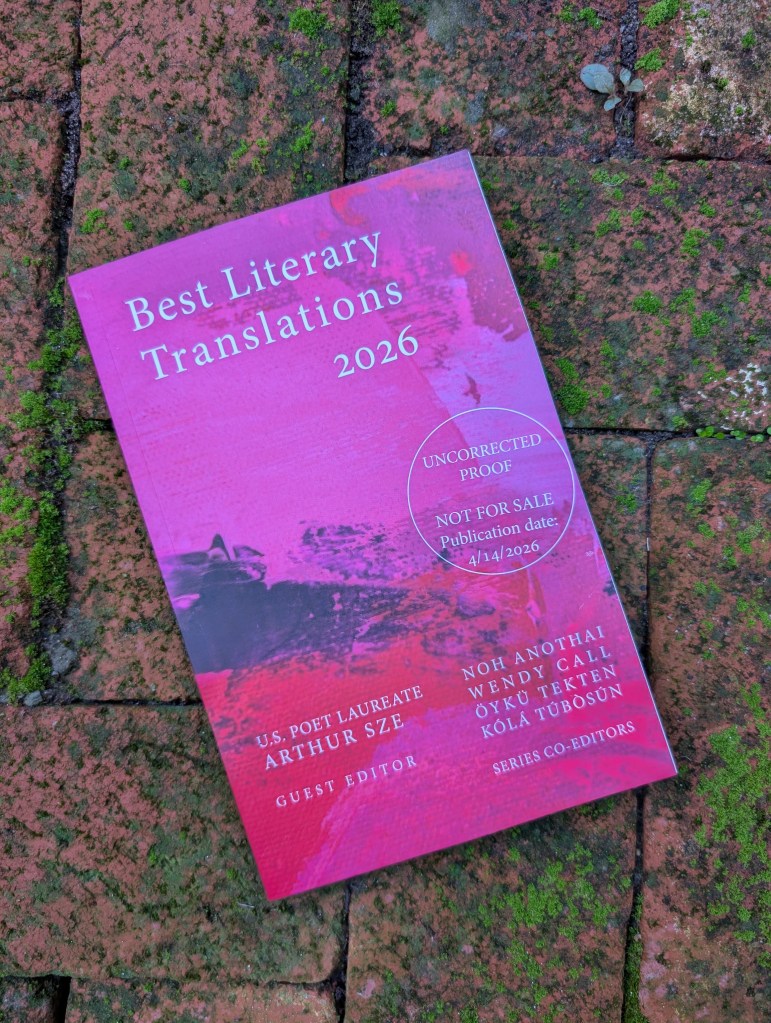
In other news, my translations from the work of Olga Bragina have received two recent honors. * Editors of ANMLY nominated the poems they published for a Pushcart Prize. * One of the poems published by Consequence, has been chosen to appear in Best Literary Translations 2026 anthology, forthcoming from Deep Vellum Press. So delighted! Olga Bragina’s work deserves more recognition.
This summer, Yelena Furman and I have been able to add several publications to Punctured Lines, our feminist blog on post-Soviet and diaspora literature. We pride ourselves in amplifying work by writers from underrepresented groups in our literary space. Dive in: * We Have to Go Back: Speculative Fiction, Nostalgia, and the Ghosts of Bookshelves Past, Guest Essay by Kristina Ten * Queering Peripheries: Lara Vapnyar’s “Lydia’s Grove”: Soviet-Born: The Afterlives of Migration in Jewish American Fiction by Karolina Krasuska * Seven Forty: Memoirs of a Jewish District Attorney from Soviet Ukraine by Mikhail Goldis, translated, edited, and with an Introduction by Marat Grinberg * Graphic Novels and Memoirs of Soviet Trauma
(Apologies for the TOY STORY reference in my subject line. It’s stuck in my brain and won’t go away.)
Many of you have heard me talking about my “Tuesday night writers group.” Back in 2006, I started sharing my fiction with some of my comparative literature grad school friends, and one of them pointed me to this public, drop-in workshop that at the time was meeting in the basement of an art gallery near Union Square in San Francisco. The first time I showed up, the moderator, Tamim Ansary called on me to read my story outloud, and as I did so, something clicked: I didn’t recognize my own voice. I’d been reading and thinking about voice in literature from a scholarly point of view, but here I was experiencing my own voice as an embodied thing. It felt stilted, unsure of itself. I could do it better, differently. I could learn. It didn’t hurt that Tamim actually liked whatever it was I read and encouraged me to come back.
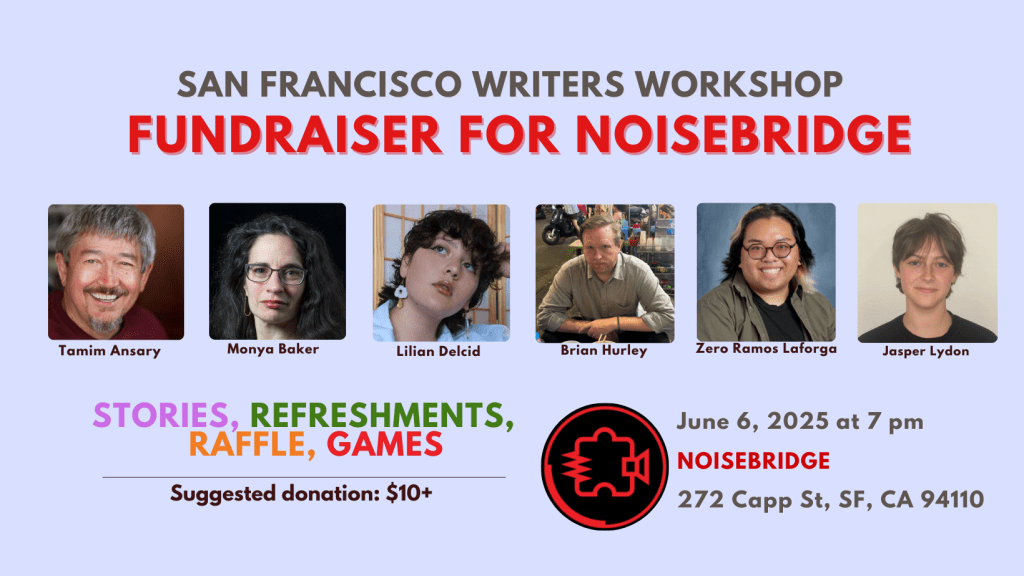
This summer marks ten years since I, Judy Viertel, and Kurt Wallace took over from Tamim in moderating the San Francisco Writers Workshop, with Monya Baker joining us later. These days, the workshop is meeting at a hackerspace in the Mission, Noisebridge, and this coming Friday, June 6 at 7 pm, we’ll be gathering there to celebrate the workshop and to fundraise for our venue. Noisebridge allows us space to meet for free, while their own rent is sky high. In addition to hosting our group, Noisebridge also provides a stage for Lit Crawl and other literary gatherings throughout the year. I’ve been encouraging everyone I know to donate what they can to help support this organization that contributes to the vitality of San Francisco’s literary scene.
And please come party with us on Friday! Tamim Ansary himself will be there, presenting his new and very topical book, TRUTHER NARRATIVES. Current co-moderator Monya Baker will also read, and I’m so proud to introduce a few of our current regulars. We will have a book raffle, a storytelling game, food, and an opportunity to tour Noisebridge. I made some nifty postcards and clipboards — you will want one!
Three additional items:
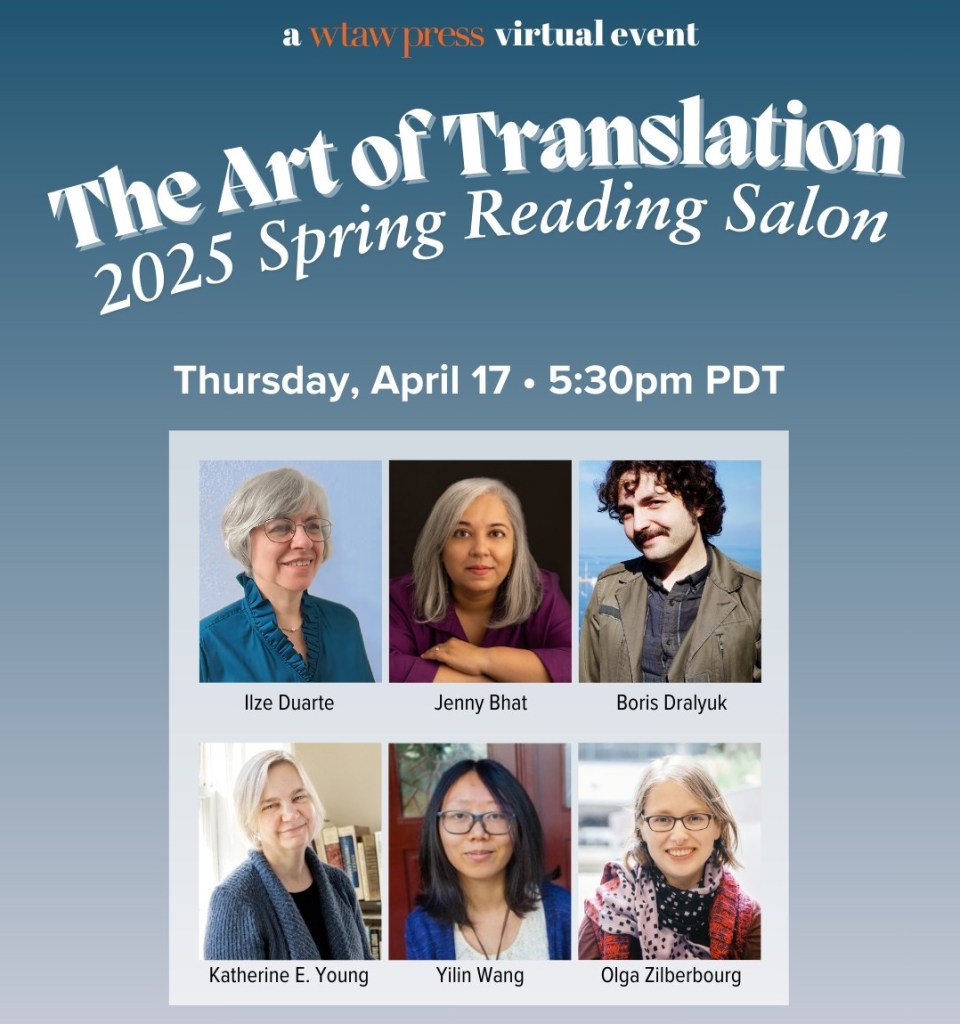
* Check out this YouTube recording of a conversation about literary translation I hosted back in April for WTAW Press. Featured here are Ilze Duarte, Katherine E. Young, Jenny Bhatt, Boris Dralyuk, and Yilin Wang — translating work from Brazilian, Russian, Gujarati, and Chinese. Do email me if you read any of the books mentioned. I’m so curious to hear what makes an impression.
* My publisher, Peg Alford Pursell (whom I first met at the San Francisco Writers Workshop) asked me to judge the second annual Kevin McIlvoy Book Prize. The results are in: the winner is THIS IS ALSO LIFE by Elle Therese Napolitano. This book is an intimate portrait of two women affected by domestic violence to various degrees. Its inventive structure allows a realistic representation of the aftermath of violence and hopefully will be appreciated by other readers when the book is published by WTAW Press. Keep an eye out for it!
* Another group of the writers workshop regulars are putting together a new literary reading on Sunday June 8 at a wine bar in the Mission. Literary scene in SF is clearly *on fire*! Please welcome Public Words! I’m planning on being there. Come hang out.
My next event is taking me to Sebastopol, California — a small town north of San Francisco, famous for its apple harvest. My friend, writer Tania Malik, invited me to participate on a panel in Sebastopol’s Lit Crawl this coming Saturday, May 17. I hope to see some of you there!
Built on the land first inhabited by the Coast Miwok and Pomo peoples, Sebastopol apparently got its current name in an 1854 gunfight between two gold diggers, one of whom, a man named Hibbs, barricaded himself inside a general store.”Hibbs’s Sebastopol!” cried the onlookers steeped in the international news of the day. They were referring to the siege of Sebastopol–an episode of the Crimean war–vividly described for the later generations by Lev Tolstoy in The Sevastopol Sketches, Alfred Tennyson, and others.
I, too, have a story that’s partially set in Sevastopol (today, we transliterate the Greek-inspired Russian name of the Crimean town most often with a “v”). In “The Green Light of Dawn,” first published by Epiphany Magazine in 2015, a young woman treks alone on the coast of Crimea, Ukraine to mourn a relationship–a relationship with a man who died, a relationship with her country that ceased to be. I will read the beginning of this story for this event, centered around the idea of “the road.”
My thoughts remain with Ukraine these days. I’m grateful to the editors of ANMLY, a literary magazine interested in experimental international literature, for publishing five more of my translations from the work of the Kyiv-based poet Olga Bragina. Olga wrote these poems in 2023, a year after Russia’s full-scale invasion of Ukraine, and I only wish they could be less relevant today. Russia is continuing its near daily bombings of the civilian population in Ukraine. Please continue donating to relief efforts if you can.
Earlier this month, World Literature Today published my prose translation of a story by Vsevold Garshin that I called “A Captive Palm.” First written in 1879, the story felt contemporary in its personification of tropical plants languishing in a hostile environment of an imperial botanical garden. As I write in the accompanying essay, I was inspired to translate this story by a set of coincidences and also because I’m fascinated with the longevity of plants and ideas—our contemporary dilemma of how to ethically and sustainably build a future in a world shaped by brutal colonial conquests rhymes with the revolutionary thoughts Garshin is attributing to his palm tree.
Thank you all for reading, staying in touch, and coming out to literary events! In the future, I hope to do more Zoom-based events for people outside of the Bay area. Here’s a YouTube recording from a Mom Egg Review (MER) issue release party a few weeks ago, featuring a great many wonderful poets and a few of us, fiction writers. I read the opening of my story “The Train is Coming.”
“My son wants to take the streetcar. My daughter doesn’t. She doesn’t want to walk, either.” A new fiction of mine, “A Train is Coming,” appears in the upcoming issue of Mom Egg (MER) Review 23, copy available for purchase as a PDF and in print. If you want to hear me read it out loud on Zoom, register for the issue release party (free), where I’m delighted to share the stage with my friend, poet Olga Livshin, among others.
If you can only make it to one Zoom-based Olga Z event this month, I strongly encourage you to come to the translation salon I’ll be MCing on April 17th. Coorganized by translator Ilze Duarte and hosted by WTAW Press (that published my collection), this event will bring to you some of the leading literary translators of the English-speaking world, representing writers from Brazil, India, Ukraine, Azerbaijan, and China. Readers of this newsletter will recognize the names of Boris Dralyuk, who translates Andrey Kurkov, and Katherine E. Young, the translator of Akram Aylisli. It so happens that all of the translators on this reading are also writers and poets themselves, and I only wish I had the time to interview them about how they combine their own writing with their translation projects. One thing for sure, they’re masters of the English letters, opening worlds into other languages and cultures for us. Register (it’s a virtual, Zoom-based event)! This will be fun.
Bay Area locals: I have one more event to invite you to. On May 4, at 1 pm, I’ll be taking a part in a brand new Jewish Arts & Bookfest, being organized at the UC Berkeley’s Magnes collection, “one of the world’s preeminent Jewish museums” (I’m just learning about it too). I’m moderating a panel we called Between War and Peace, on the role of Russian literature in the work of Soviet-born Jewish American writers, featuring Margarita Meklina, Tatyana Sundeyeva, and Sasha Vasilyuk. How did we get from worshipping Pushkin, Akhmatova, and Bulgakov to writing about Soviet Jewish–and often female–experiences? How do the structures and ideas of Russian and Soviet lit continue to affect our own storytelling? How does the popularity of Russian lit in the US intersect with our USSR-formed experiences of it, and what do we do with the image of a “Russian writer” as a bearded white (and ethnically Russian) man? Following my conversation with Marat Grinberg, I have ever more questions. Please join me.
And to continue the theme of Soviet-born writers, I’m leaving you with the recording from the event that took place in Los Angeles in March, a reading by this amazing group of writers born in the USSR, and translators working with the post/Soviet experience. Thank you to Olga Livshin for capturing and editing this video. We called this event Diaspora Writers Against War, and we’re continuing to do what we can to raise funds in support of Ukraine. Please donate to Ukraine TrustChain.
I’m delighted to invite you to a one of a kind event happening in Los Angeles on March 28: a reading at the Wende Museum by eighteen writers and translators from the former USSR. We’re coming together to share our work, to get to know each other, and also to eat Ukrainian food (a Ukrainian food truck is expected!) and to support Ukraine.
Register on Eventbrite and if you can’t come, please share this with your friends in LA. Irina Reyn will be there! Katya Apekina! Kristina Gorcheva-Newberry! Our star translators and poets! Did I mention eighteen readers? Each of them, a star.
Expect humor; tales and poems of sex, identity crises, parenting, cultural intersections, immigration, and war. The Wende Museum is dedicated to art and artifacts from the Cold War era, and they are currently running an exhibit called “Undercurrents II: Archives and the Making of Soviet Jewish Identity,” which aligns so closely to what many of us write about. The museum kindly agreed to stay open late for us, until 6 pm, and we’re encouraging people to get there early so that they can tour the exhibit. So: register!
For friends who can’t make it to LA, I have a Zoom event this coming Monday, March 17, 7-8 pm Pacific. Together with writers Jen Siraganian, former Poet Laureate of Los Gatos, and Christin Rice, author of The ABC’s of Pandemic Parenting (Permutation Press), we will be reflecting on the 5th anniversary of the pandemic lockdown. The lockdown has changed our lives in ways that we still feel today. I find it useful to recall the first day, week, month of it, and so I plan to read from my diary–the notes that I managed to capture in the midst of the insanity. To tune in, register here: https://us06web.zoom.us/meeting/register/M-q9F0MfRimjwisnh0uaLQ
I published two new creative pieces in the past month:
“Where does your motherland begin? Does it begin with a picture in a primer, with treasured friends who live down the street? With your mother’s song?”
Radio Baltica, an Essay, about the teenage experience of growing up during my country’s collapse–it’s all about the music of the era and, of course, The Beatles. Thanks to Tint Journal based in Graz, Austria for publishing this piece. I recorded an audio track, so you can hear me reading this essay out loud. Also included is a link to a Spotify playlist where I collected most of the songs I reference. I limited myself to only one Beatles tunes, to be polite, I guess. Alla Pugacheva is here to enchant!
“A seven-year-old girl falls in love with a book and tells herself, I want to read every book in the world.”
New story: “A Woman of Learning,” in Weavers Literary Review. No link here because this mag is print only for now. I have a couple of copies, so let me know if you want one — or feel free to order and support the publishers. The magazine by Moazzam Sheikh and Amna Ali focuses on South Asian American writing, and they have a very strong curatorial vision. I’m honored to have my story included, especially given that my geographies aren’t an immediate match.
I’m taking a break from book reviewing at the moment; that being said, I want to point out two book-related pieces I wrote:
To accompany my recent review of Avtodya Panaeva’s The Talnikov Family, I interviewed the translator Fiona Bell as well as Panaeva scholar Margarita Vaysman. To learn more about an incredible 19th century Russian female writer, a woman who helped run a most influential literary magazine, do read this Q&A: Narrating a Violent Childhood on Punctured Lines–here are so many insights!
I never miss a chance to gush about a favorite writer. This time, the question “what are you reading now?” from The Common arrived just as I was finishing Bohumil Hrabal’s I Served the King of England.
Next week, February 26 at 7 pm, I’ll be reading my work as a part of a long-standing Lyrics & Dirges reading series at Pegasus Books in downtown Berkeley (2349 Shattuck Ave).
I have neither a lyric, nor a dirge, but I might read the latest version of my novel opening, to see how it runs. Hope to see some of you there!
Whether or not you can make it, do read a story of mine just out from Paper Brigade Daily, “Dodo’s Graduation.” I drafted this fiction in June 2021 and workshopped it on Zoom, and the piece is a reflection on the aftereffects of COVID-era lockdown, the San Francisco version.
Thanks to those of you who were able to attend my Zoom conversation with Marat Grinberg about his book The Soviet Jewish Bookshelf (Brandeis UP), hosted by the Oregon Jewish Museum and Center for Holocaust Education. For those of you who weren’t able to make it, here’s the YouTube recording — where I got to gush about some of my favorite books growing up. The list of all the books mentioned is in the comments below.
Last but not least, here’s my latest book review — and one of the trickiest I’ve ever written: The Lady of the Mine by Sergei Lebedev, translated by Antonina W. Bouis, in On the Seawall. Boris Fishman reviewed this book for the New York Times, and his piece is worth reading for the humor, but if you want to know what the book is about, read my piece.
Once again, it’s Litquake season in San Francisco! My schedule is, unfortunately, being hijacked by the fact that my kids’ amazing local public elementary school, Harvey Milk Civil Rights Academy, is in peril as a result of the district’s financial mismanagement, and in the last 10 days I’ve been involved in helping to organize 2 rallies and multiple other initiatives to try to #saveourschools.
But! Litquake is not to be missed and there are so many exciting and important events that are on the schedule. Check it out.
I’m participating in three events. The first will be this coming Monday, 6:30 pm at 297 Page Street. Called Golden State: Stories about Life on the Left Coast, it’ll feature about 15 readers, including me, performing our flash fictions. This event is currently sold out on Eventbrite, but don’t let that stop you. Tickets are free, and Eventbrite isn’t that reliable as a predictor of attendance for free events. Come!
October 26, the last day of the festival, is also when Lit Crawl happens: starting at 5 pm that Saturday, literary readings will take over the Mission neighborhood. I am helping to organize two events.
At 5 pm, come to Manny’s for a reading we’re calling Passionate Thinking in Diaspora to hear a fantastic group of writers who were born in Ukraine, Russia, and Moldova. This is our third time doing an event at Lit Crawl, and we’re excited to return with all new stories. Find more details about the event, including our bios, on Punctured Lines.
To continue Lit Crawl extravaganza, I invite you to follow me to Noisebridge, where at 6:30 pm on October 26, I’ll be helping to emcee a presentation of the San Francisco Writers Workshop–the longest running writing workshop probably anywhere!–featuring our current moderators and regulars, with stories spanning different genres, centuries, continents (including imagined ones). Can’t wait to hear and celebrate this crew. Find more details on the San Francisco Writers Workshop’s page.
And yes, I’m heading to the afterparty at the end of the festival. Dunno if there will be any awkward dancing this year, but I promise to contribute my share of awkward yet impassioned conversation on any topic you like. Including, yes, the school district, omg.
San Francisco friends: Come next Thursday to Martuni’s on Market Street. It’s a great reading series hosted by a wonderful poet James J. Siegel, and I’m so happy to be invited back. It’s always so much fun! Pro tip: the drinks are really strong.
New publications:
I was delighted to see my translation of a poem by Kyiv-based writer Olga Bragina in Cagibi. I have been experimenting with literary translation in a low-key way for many years, and I am very grateful to Olga for trusting me with her work. Two more poems from this cycle are slated to appear in World Literature Today and five more in Consequence, and I’m hoping to place more elsewhere.
A new fiction of mine, “Untrampled by Horses,” appears in Defenestration. It’s a humor piece. It’s supposed to be funny!