Many of you have heard me talking about my “Tuesday night writers group.” Back in 2006, I started sharing my fiction with some of my comparative literature grad school friends, and one of them pointed me to this public, drop-in workshop that at the time was meeting in the basement of an art gallery near Union Square in San Francisco. The first time I showed up, the moderator, Tamim Ansary called on me to read my story outloud, and as I did so, something clicked: I didn’t recognize my own voice. I’d been reading and thinking about voice in literature from a scholarly point of view, but here I was experiencing my own voice as an embodied thing. It felt stilted, unsure of itself. I could do it better, differently. I could learn. It didn’t hurt that Tamim actually liked whatever it was I read and encouraged me to come back.
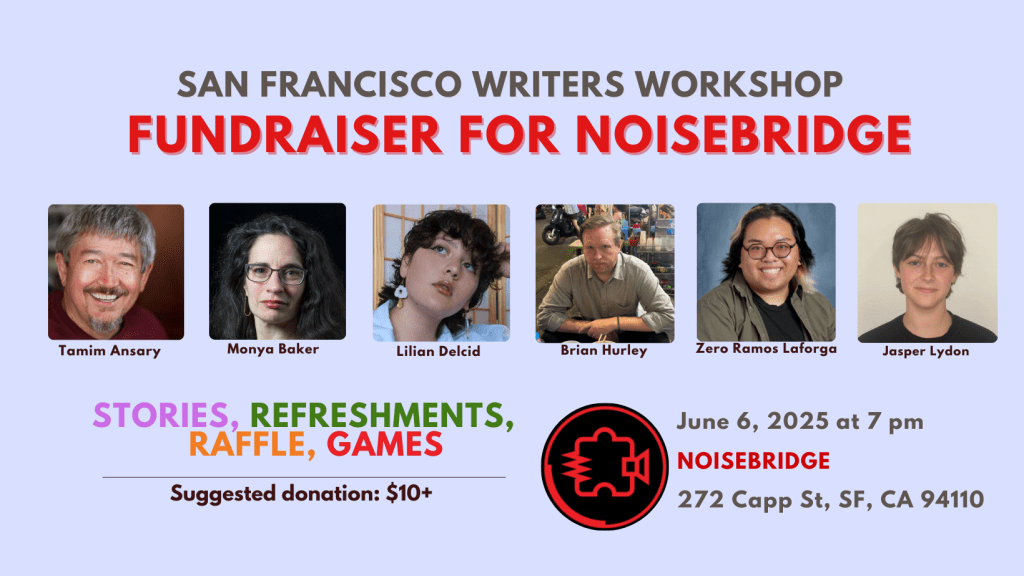
This summer marks ten years since I, Judy Viertel, and Kurt Wallace took over from Tamim in moderating the San Francisco Writers Workshop, with Monya Baker joining us later. These days, the workshop is meeting at a hackerspace in the Mission, Noisebridge, and this coming Friday, June 6 at 7 pm, we’ll be gathering there to celebrate the workshop and to fundraise for our venue. Noisebridge allows us space to meet for free, while their own rent is sky high. In addition to hosting our group, Noisebridge also provides a stage for Lit Crawl and other literary gatherings throughout the year. I’ve been encouraging everyone I know to donate what they can to help support this organization that contributes to the vitality of San Francisco’s literary scene.
And please come party with us on Friday! Tamim Ansary himself will be there, presenting his new and very topical book, TRUTHER NARRATIVES. Current co-moderator Monya Baker will also read, and I’m so proud to introduce a few of our current regulars. We will have a book raffle, a storytelling game, food, and an opportunity to tour Noisebridge. I made some nifty postcards and clipboards — you will want one!
Three additional items:
* Check out this YouTube recording of a conversation about literary translation I hosted back in April for WTAW Press. Featured here are Ilze Duarte, Katherine E. Young, Jenny Bhatt, Boris Dralyuk, and Yilin Wang — translating work from Brazilian, Russian, Gujarati, and Chinese. Do email me if you read any of the books mentioned. I’m so curious to hear what makes an impression.
* My publisher, Peg Alford Pursell (whom I first met at the San Francisco Writers Workshop) asked me to judge the second annual Kevin McIlvoy Book Prize. The results are in: the winner is THIS IS ALSO LIFE by Elle Therese Napolitano. This book is an intimate portrait of two women affected by domestic violence to various degrees. Its inventive structure allows a realistic representation of the aftermath of violence and hopefully will be appreciated by other readers when the book is published by WTAW Press. Keep an eye out for it!
* Another group of the writers workshop regulars are putting together a new literary reading on Sunday June 8 at a wine bar in the Mission. Literary scene in SF is clearly *on fire*! Please welcome Public Words! I’m planning on being there. Come hang out.

With appreciation for you all,
Olga
 otagonist, arrives here as a boy of four. A farmer adopts him and treats him cruelly. Egger, nevertheless, builds a life, marries, goes to war, returns, watches the world change around him as he becomes a stalwart of his valley and earns his living by leading groups of tourists through the mountains. I’m reading this novel as a meditation about stewardship of the land, an exercise of imagination about how to live lightly. It takes a certain set of experiences, good and bad luck, to get there. Here’s a sign that Egger paints to advertise his business:
 Olga Zilberbourg