Three years ago, in preparation for a literary reading in support of Ukraine, I asked a Kyiv-based poet Olga Bragina for the permission to translate her poems. I’d been reading her poems on Facebook and had become a fan, and I had an idea of how she might sound in my English. Though I’d been writing in English for a couple of decades at that point, as a translator I was a newbie. But, I dared. And Olga kindly took a chance on me.
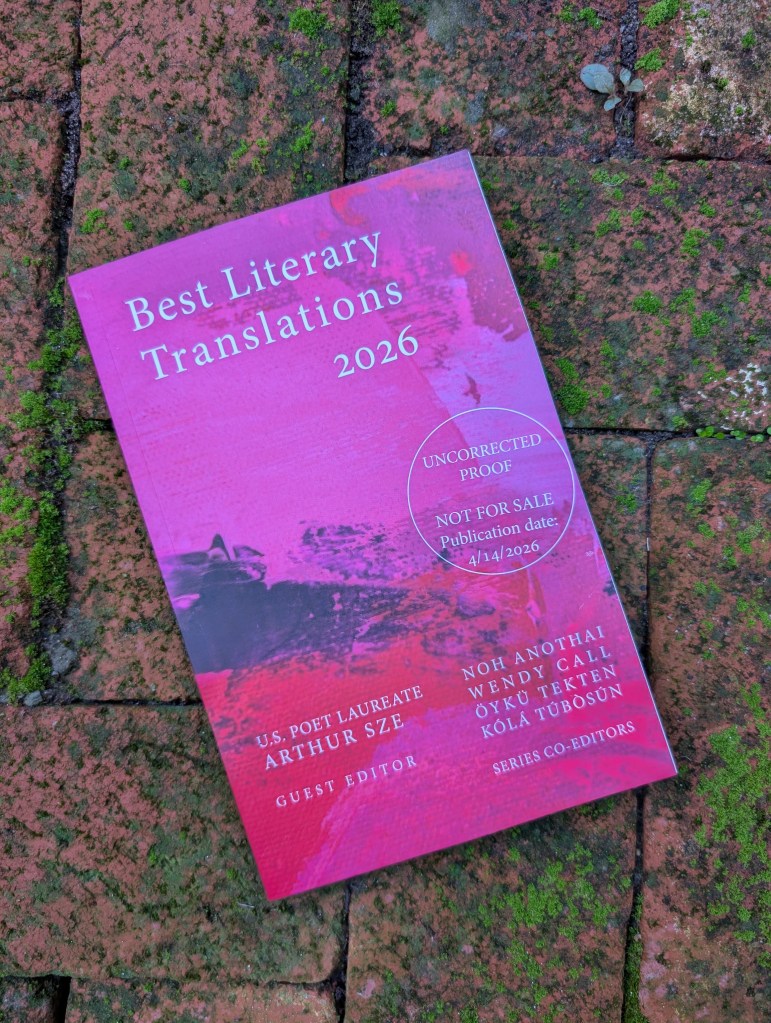
It’s very rewarding that one of my translations of her poems, first published by Consequence, has been selected to appear in Best Literary Translations 2026, an anthology coming out from Deep Vellum Press. This poem was chosen by the new U.S. Poet Laureate Arthur Sze, and also by the series co-editors, Noh Anothai, Wendy Call, Öykü Tekten and Kọ́lá Túbọ̀sún. (Wendy Call is the editor I’ve been most directly in touch with, and I’m so impressed with her energy and dedication.)
It’s a beautiful book that collects a great many powerful and unexpected voices. For a reader, it’s a thrilling ride. Please pre-order a copy from the publisher, and ask your library to order a copy. Rate and review to amplify!
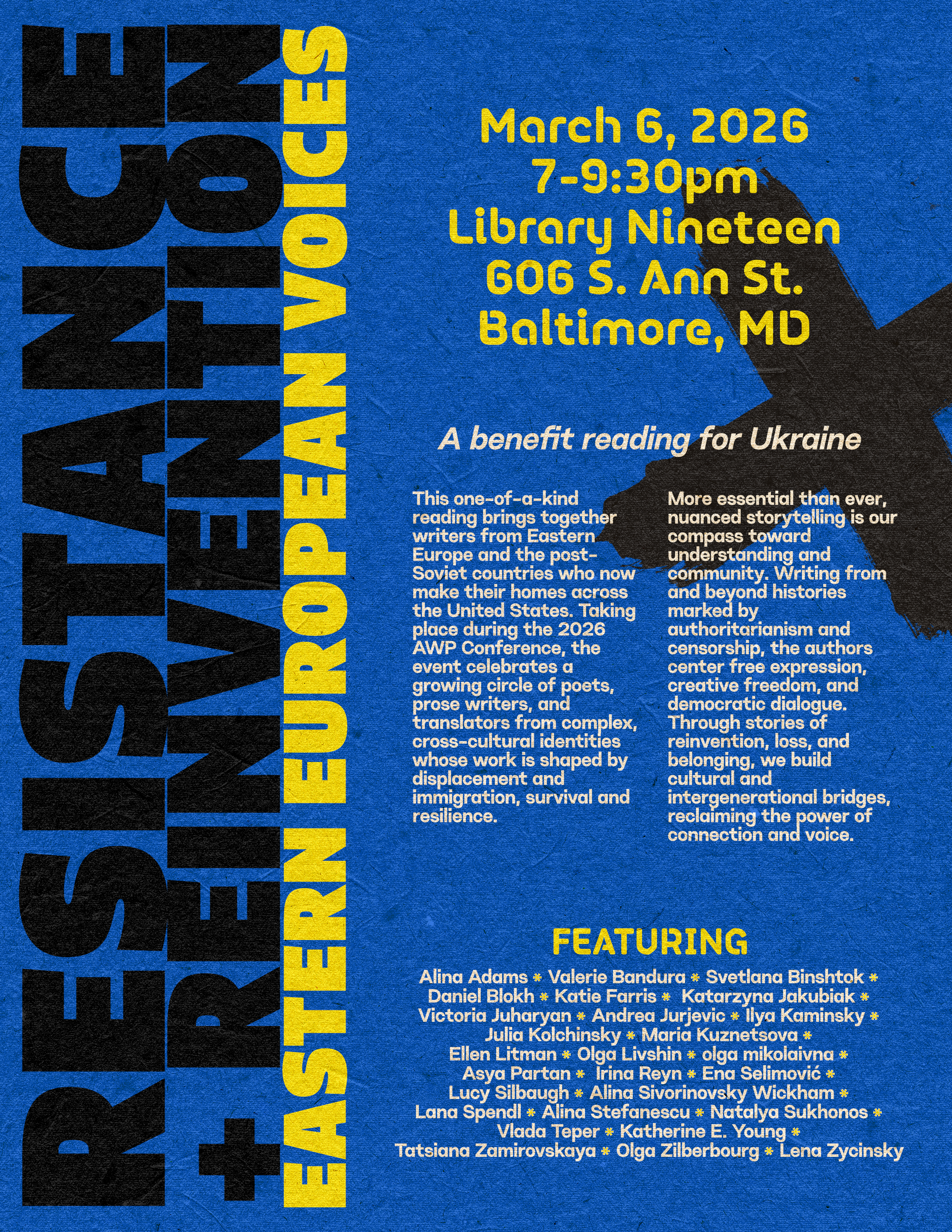
Russia’s war against Ukraine continues. Most of you have probably seen the reporting about Russia’s assault on Ukraine’s electric grid, among other horrors. As creative writers, my peers and I respond to this aggression in a variety of ways from a wide range of our subjective positions. If you can be in Baltimore on March 6th this year, come to the event I describe below to hear 26 (!!) of us.
For more details, take a look at our Eventbrite page. If you’re able to attend, please do register. We expect this event to sell out. Please bring friends and share with people you know in Baltimore and Washington, DC area. And whether or not you can make it, donate to Ukraine TrustChain or your favorite organizations that support Ukraine.
Here in San Francisco, the rainy season has officially begun with the first mild and fairly warm storms of the season. Who knows what new cataclysms it might bring? As my friend Gary Pendler writes in his essay “The Bike, the Branch, and the Tick”(*), after a poplar tree branch bizarrely dropped on him in Paris, we have to be prepared that “climate change might also show up in the lives of us ordinary folk and in a myriad of day-to-day incidents.”
The best place to hide from falling branches is, to my mind, a bookstore. And, speaking of Paris, I’ve been spending a lot of time there in my imagination as I’m reading my friend Bart Schneider’s book GIACOMETTI’S LAST RIDE. Giacometti, born in Switzerland, worked in Paris, and this is where Bart’s novel is set. Bart brings to life this consummate artist, in all of his human complexities and vulnerabilities. It’s a thrilling read!
Giacometti, of course, is much beloved all across Europe and the US. But when Bart first brought pages of his manuscript to the workshop that I was a part of, I had been clueless. Bart’s chapters were my first introduction to Giacometti’s legacy. Giacometti, it turns out, was one of those modernist artists who was ideologically unacceptable to the USSR, and so censored there out of existence. The first showing of his work in Russia took place in 2007. Digging deeper, I discovered this wonderful piece above by emigre artist Leonid Sokov (1987), that showcases the clash of cultures: The Meeting of Two Sculptures: Lenin and Giacometti.
In many ways Giacometti’s art, showcasing the fragility of an individual, remains political in today’s world. I’m excited to be able to talk about all this and more with Bart, who will be presenting his novel on November 8, 6:30 pm, at Telegraph Hill Books in San Francisco. I hope you can come!
I’ll also be reading from a longer essay of mine “The Richest Kid in the World” (*) that dramatizes the end of censorship in the Soviet Union.
In the spirit of continuing to unpack modernity through the post-Soviet lens while building community, I am hosting two more events this November.
1) I’m absolutely thrilled that Hamid Ismailov and Shelley Fairweather-Vega will be doing an event in San Francisco for their book WE COMPUTERS, A Ghazal Novel (Yale University Press). This book is a National Book Award finalist–the first book from Central Asia to be a finalist.
Exiled from Uzbekistan (where his books are banned), Ismailov lives in the UK. He writes in at least three languages: Uzbek, Russian, and English, and Fairweather-Vega can translate him directly from Uzbek, without going through Russian. A previous novel of Ismailov’s that Fairweather-Vega translated, GAIA, QUEEN OF THE ANTS, did a fantastic job of telling contemporary stories set in the Western world, yet tying them both to immediate Soviet and post-Soviet history of Central Asia as well as to mythological history and philosophy. It offers a truly unique and fascinating perspective on the modernity–as I expect WE COMPUTERS does as well.
Come to see this stellar duo on November 9, 6 pm at The Sycamore (2140 Mission St)!!
2) On Tuesday, November 4, 4:30 pm, I’ll be introducing a feminist philosopher from the former Yugoslavia, Senka Anastasova, at Philosophers Club (824 Ulloa St).
Anastasova is a professor of aesthetics and political philosophy at the Faculty of Dramatic Arts and Humanities, at Ss. Cyril and Methodius University in Skopje. She will be introducing her Routledge Press book, POLITICAL NARRATOSOPHY: From Theory of Narration to Politics of Imagination (on Nancy Fraser, Jacques Ranciere, Paul Ricoeur).
She promises to speak on her history of “displacement, philosophy of narrating – in – the – zones – of transition, pain, dead bodies / and not – yet – dead displaced bodies, poetics of displacement and immigration, history /herstory, historiography, women’s studies and borderlands, types of exiles from one regime to another, about memory, resistance against totalitarian regimes, capital, historical materialism, freedom to choose, freedom to express today.”
This will be absolutely wild! Come.
(*) And yes, this message comes with a footnote! Gary’s essay “The Bike, the Branch, and the Tick,” and mine “The Richest Kid in the World” both appear in the same issue of the Chicago Quarterly Review. There are so many goodies there!
As many of you know, October is Litquake month in San Francisco — our annual literary festival is already underway, with many entertaining, educational, and inspiring events. On October 25 (Saturday), the festival ends with Lit Crawl — a literary pub crawl through the Mission neighborhood.
I’m participating in two events. In Phase 1, from 5-6 pm, find me at Ruth’s Table (3160 21st St), with my fellow immigrant writers from the former USSR. This year, our theme is “Owning Fear, Reaching for Freedom.” We’re reflecting on how our community experience of living under a totalitarian regime has prepared us for the current political moment. And though the theme is as grim as the times, I promise you that the event won’t be. Events with this group of writers and translators are a wonderful occasion to celebrate community and each other’s work. We’re here to support and encourage each other to tell more stories. Too much has been silenced and swept under the rug. We’re trying to bring it all out in the open. It’s a joyous occasion!
Then, for Phase 2, from 6:30 to 7:30 pm, I head to Noisebridge (272 Capp Street), where I will continue to celebrate my writers group. Every Tuesday night, we gather together to read each other our story drafts and to give and receive feedback on our work. This is how we learn to build stronger, more clear and nuanced, stories.
During this event, five of our amazing writers will share their work and tell us about how they’ve revised it after receiving feedback. Then, we’ll ask our audience to critique a story. Guaranteed laughs! (And also maybe it will make revision more approachable to people.)
Looking beyond Litquake, on Saturday, November 8, at 6 pm, I will be reading at Telegraph Hill Books alongside my friend Bart Schneider, who has just published his novel GIACOMETTI’S LAST RIDE, about the final romance of a famous Swiss sculptor, Alberto Giacometti. It’s a gorgeously produced book with illustrations by a well-known Sonoma-based artist, Chester Arnold. Bart will introduce the novel, and I will read some of my new work, and then we can talk about books and hang out. Join us!
In other news, my translations from the work of Olga Bragina have received two recent honors. * Editors of ANMLY nominated the poems they published for a Pushcart Prize. * One of the poems published by Consequence, has been chosen to appear in Best Literary Translations 2026 anthology, forthcoming from Deep Vellum Press. So delighted! Olga Bragina’s work deserves more recognition.
This summer, Yelena Furman and I have been able to add several publications to Punctured Lines, our feminist blog on post-Soviet and diaspora literature. We pride ourselves in amplifying work by writers from underrepresented groups in our literary space. Dive in: * We Have to Go Back: Speculative Fiction, Nostalgia, and the Ghosts of Bookshelves Past, Guest Essay by Kristina Ten * Queering Peripheries: Lara Vapnyar’s “Lydia’s Grove”: Soviet-Born: The Afterlives of Migration in Jewish American Fiction by Karolina Krasuska * Seven Forty: Memoirs of a Jewish District Attorney from Soviet Ukraine by Mikhail Goldis, translated, edited, and with an Introduction by Marat Grinberg * Graphic Novels and Memoirs of Soviet Trauma
(Apologies for the TOY STORY reference in my subject line. It’s stuck in my brain and won’t go away.)
My next event is taking me to Sebastopol, California — a small town north of San Francisco, famous for its apple harvest. My friend, writer Tania Malik, invited me to participate on a panel in Sebastopol’s Lit Crawl this coming Saturday, May 17. I hope to see some of you there!
Built on the land first inhabited by the Coast Miwok and Pomo peoples, Sebastopol apparently got its current name in an 1854 gunfight between two gold diggers, one of whom, a man named Hibbs, barricaded himself inside a general store.”Hibbs’s Sebastopol!” cried the onlookers steeped in the international news of the day. They were referring to the siege of Sebastopol–an episode of the Crimean war–vividly described for the later generations by Lev Tolstoy in The Sevastopol Sketches, Alfred Tennyson, and others.
I, too, have a story that’s partially set in Sevastopol (today, we transliterate the Greek-inspired Russian name of the Crimean town most often with a “v”). In “The Green Light of Dawn,” first published by Epiphany Magazine in 2015, a young woman treks alone on the coast of Crimea, Ukraine to mourn a relationship–a relationship with a man who died, a relationship with her country that ceased to be. I will read the beginning of this story for this event, centered around the idea of “the road.”
My thoughts remain with Ukraine these days. I’m grateful to the editors of ANMLY, a literary magazine interested in experimental international literature, for publishing five more of my translations from the work of the Kyiv-based poet Olga Bragina. Olga wrote these poems in 2023, a year after Russia’s full-scale invasion of Ukraine, and I only wish they could be less relevant today. Russia is continuing its near daily bombings of the civilian population in Ukraine. Please continue donating to relief efforts if you can.
Earlier this month, World Literature Today published my prose translation of a story by Vsevold Garshin that I called “A Captive Palm.” First written in 1879, the story felt contemporary in its personification of tropical plants languishing in a hostile environment of an imperial botanical garden. As I write in the accompanying essay, I was inspired to translate this story by a set of coincidences and also because I’m fascinated with the longevity of plants and ideas—our contemporary dilemma of how to ethically and sustainably build a future in a world shaped by brutal colonial conquests rhymes with the revolutionary thoughts Garshin is attributing to his palm tree.
Thank you all for reading, staying in touch, and coming out to literary events! In the future, I hope to do more Zoom-based events for people outside of the Bay area. Here’s a YouTube recording from a Mom Egg Review (MER) issue release party a few weeks ago, featuring a great many wonderful poets and a few of us, fiction writers. I read the opening of my story “The Train is Coming.”
“My son wants to take the streetcar. My daughter doesn’t. She doesn’t want to walk, either.” A new fiction of mine, “A Train is Coming,” appears in the upcoming issue of Mom Egg (MER) Review 23, copy available for purchase as a PDF and in print. If you want to hear me read it out loud on Zoom, register for the issue release party (free), where I’m delighted to share the stage with my friend, poet Olga Livshin, among others.
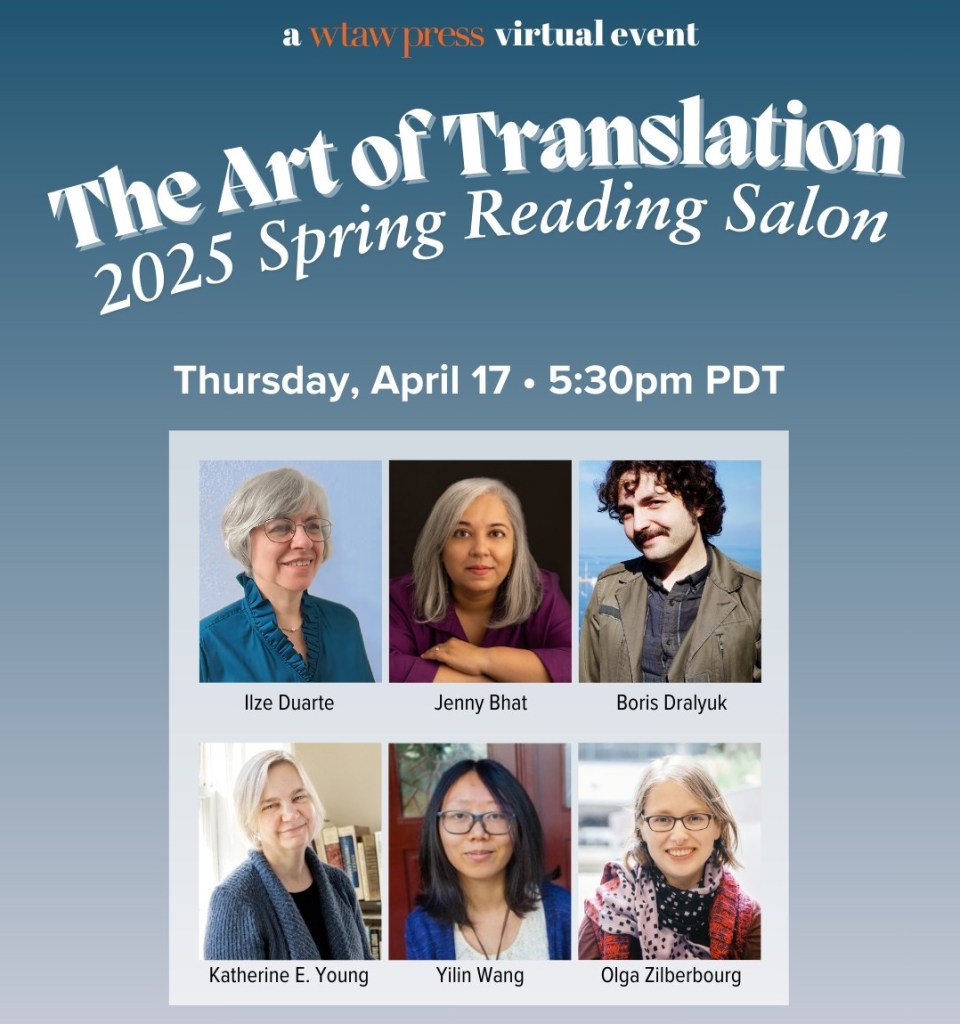
If you can only make it to one Zoom-based Olga Z event this month, I strongly encourage you to come to the translation salon I’ll be MCing on April 17th. Coorganized by translator Ilze Duarte and hosted by WTAW Press (that published my collection), this event will bring to you some of the leading literary translators of the English-speaking world, representing writers from Brazil, India, Ukraine, Azerbaijan, and China. Readers of this newsletter will recognize the names of Boris Dralyuk, who translates Andrey Kurkov, and Katherine E. Young, the translator of Akram Aylisli. It so happens that all of the translators on this reading are also writers and poets themselves, and I only wish I had the time to interview them about how they combine their own writing with their translation projects. One thing for sure, they’re masters of the English letters, opening worlds into other languages and cultures for us. Register (it’s a virtual, Zoom-based event)! This will be fun.
Bay Area locals: I have one more event to invite you to. On May 4, at 1 pm, I’ll be taking a part in a brand new Jewish Arts & Bookfest, being organized at the UC Berkeley’s Magnes collection, “one of the world’s preeminent Jewish museums” (I’m just learning about it too). I’m moderating a panel we called Between War and Peace, on the role of Russian literature in the work of Soviet-born Jewish American writers, featuring Margarita Meklina, Tatyana Sundeyeva, and Sasha Vasilyuk. How did we get from worshipping Pushkin, Akhmatova, and Bulgakov to writing about Soviet Jewish–and often female–experiences? How do the structures and ideas of Russian and Soviet lit continue to affect our own storytelling? How does the popularity of Russian lit in the US intersect with our USSR-formed experiences of it, and what do we do with the image of a “Russian writer” as a bearded white (and ethnically Russian) man? Following my conversation with Marat Grinberg, I have ever more questions. Please join me.
And to continue the theme of Soviet-born writers, I’m leaving you with the recording from the event that took place in Los Angeles in March, a reading by this amazing group of writers born in the USSR, and translators working with the post/Soviet experience. Thank you to Olga Livshin for capturing and editing this video. We called this event Diaspora Writers Against War, and we’re continuing to do what we can to raise funds in support of Ukraine. Please donate to Ukraine TrustChain.
Friends, one day when we’re all old and gray, please remember to ask me what it takes for a Soviet-born Russian speaker to establish herself not only as a writer of English, but also as a translator into English.
Let me just say that I’m exorbitantly proud of myself for publishing my translations in two more US-based literary magazines. I’m so grateful to the Kyiv-based poet Olga Bragina for trusting me with her work and to the editors of the magazines for seeing what I saw in Olga’s poetry. It is so relatable and so heartbreaking.
Those of you who are writers might be interested to know that WTAW Press has asked me to be one of the jurors for their second annual Kevin McIlvoy Book Prize. If you have an unpublished prose manuscript (novels, memoirs, narrative nonfiction, essay and story collections, and hybrid works), the submissions are open until December 31, 2024. Please submit— I’d love to read your work!
As many of you know, WTAW Press published my collection LIKE WATER AND OTHER STORIES. This book turned 5 years old in September — and it’s not too late to buy it, read, and review on Goodreads and Amazon. All comments are always appreciated. Historically speaking, I haven’t always taken criticism well, but you know, I’m learning, and it’s good for me!
Three more links to this month’s publications:
My review of Shahzoda Samarqandi’s delightfully complex novel Mothersland, written originally in Persian and Tajik and translated to English by Shelley Fairweather-Vega from Russian by Youltan Sadykova. To write this review, I had to study up on the history of Soviet cotton production and the Aral Sea disaster.
On Punctured Lines, the blog that I co-run with Yelena Furman, we had two new pieces this month. First, my Q&A with Sasha Vasilyuk, whose novel about a Soviet WWII soldier with a secret Your Presence is Mandatory I highly recommend. Second, Yelena’s Q&A with Michele A. Berdy, a translator and editor extraordinaire who moved from US to the USSR in the 1970s. Wow, does she have stories to tell!
San Francisco friends: Come next Thursday to Martuni’s on Market Street. It’s a great reading series hosted by a wonderful poet James J. Siegel, and I’m so happy to be invited back. It’s always so much fun! Pro tip: the drinks are really strong.
New publications:
I was delighted to see my translation of a poem by Kyiv-based writer Olga Bragina in Cagibi. I have been experimenting with literary translation in a low-key way for many years, and I am very grateful to Olga for trusting me with her work. Two more poems from this cycle are slated to appear in World Literature Today and five more in Consequence, and I’m hoping to place more elsewhere.
A new fiction of mine, “Untrampled by Horses,” appears in Defenestration. It’s a humor piece. It’s supposed to be funny!
Publishing this story on Punctured Lines is one of the top highlights of my career as an editor so far. This publication was many years in the making. Many of my friends know Malachowskaja’s name well: she is legendary in the Soviet feminist community as one of the founders of a samizdat magazine Woman and Russia. As a result of this publication Malachowskaja, together with her fellow co-founders, was exiled from the USSR back in 1980. She has settled in Austria and has been writing and publishing books of fiction and non-fiction as well as participating in the art scene.
I believe this is her first work of fiction published in the English translation. The story, written in 2000s, fictionalizes some of her experiences from the 1970s that stood behind her feminist work. Don’t miss!
I really enjoyed talking to Eric Molinsky of Imaginary Worlds podcast about The Magician of Emerald City, the Soviet version of the Wizard of Oz. This podcast episode is about what’s gained in translation, and Eric found me through the essay I wrote last year for Lit Hub.
Translation so often as seen as a reductive process, a process of loss, and that’s really unfortunate. In this episode, Eric makes a good case–and the one that personally I find to have much better backing–that translation is a process of addition, that it really is a huge boon to the readers and writers out there. Please enjoy this episode and subscribe to the series. Eric does such an excellent job.
Here’s a new review I wrote for The Common of a remarkable book that comes to us from Azerbaijan, published thanks to the advocacy of its translator, Katherine E. Young,
Contemporary books emerging from post-Soviet countries often deal with the dehumanizing effect of the region’s systems of government on its victims, seeking to trace and partially redeem the psychological and physical harm many have suffered. For understandable reasons, few authors care to look at the perpetrators, at the people who committed murders and mass murders, informed on and denounced their neighbors. Yet, in the post-Soviet reality, often it’s these people and their descendants who have risen to the top, taken charge of the new nation states, and written their laws.
It is in this context that Akram Aylisli, in post-Soviet Azerbaijan, gathers together the three novellas and closing essay that comprise his “non-traditional novel,” Farewell, Aylis. Born in 1937, Aylisli achieved fame in the Soviet Union for his earlier trilogy People and Trees. Though pieces of this new, remarkable book have appeared in Russia, the collected Farewell, Aylis, published as a result of the efforts of his American translator, Katherine E. Young, does not yet exist in any other language.




 Olga Zilberbourg