Meet me in Washington, DC; my parents’ novel; and more good things

I’m heading to the East Coast for a conference next week, and am using an opportunity to present my work and (re)connect with writers and readers in Washington, DC area. On December 16 at 6 pm, come to “A Literary Lagniappe,” a reading and open mic by friends of Bergstrom Books, a foreign-language books purveyor in Kensingon, MD.

This event, hosted by a nearby Kensington Row Bookshop (3786 Howard Ave, Kensington, MD), will have a Central and East European focus, and will include original work, translation, and music. As you can tell from the flyer, we’re planning to keep it festive! Please register on Eventbrite and share with friends.
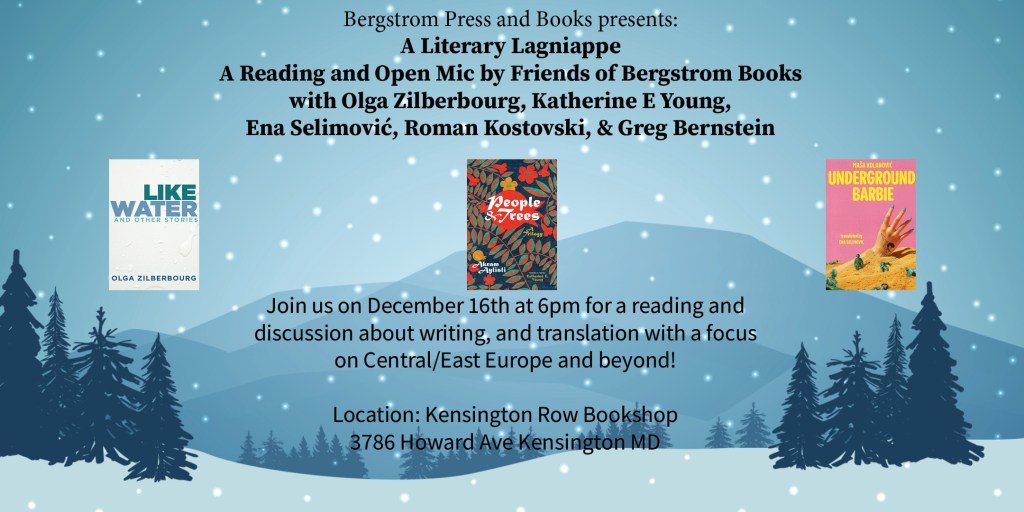
Translator and poet Katherine E. Young might read from her translations of Azerbaijani writer Akram Aylisli. Ena Selimović, Yugoslav-born translator and a co-founder of one of my favorite literary magazines, Turkoslavia, will read from Tatjana Gromača’s novella Black, newly translated. Roman Kostovski, a translator, musician, and publisher of Plamen Press, that specializes in books in translation from Central, Eastern, and Southeastern Europe (and published Aylisli’s PEOPLE AND TREES), might perform some music as well as read! Greg Bergstein, my fellow St. Petersburgian who takes inspiration from both James Joyce and Daniil Kharms might read one of his fictions.

***

In other news, check out Lina Turygina’s essay “Thinking Reeds and Foolish Weeds: On Emigration and Adaptation.” In it, Turygina (a Harvard Ph.D. student!) compares my stories with the work of Nina Berberova (!!!) –an iconic writer of the first wave of Russian emigration. “Navigating her position as a bicultural writer, Zilberbourg moves fluidly between languages, omitting details in one version, using grammar creatively in another, and always finding new ways to adapt.” My next story is going to have to feature the burdock plant — I have so many associations!

***

As some of you know, in the 60s and 70s, my dad was in a popular student rock band in Leningrad, “The Green Ants.” They performed at his university and also toured the country in the summers as a part of student work brigades.

The members of the band worked with difficult teens in Karelia, built an oil pipeline in Kazakhstan, worked on railway construction, entertained locals at a restaurant on the Kola peninsula, and at nights played rock shows, bringing Western music to Soviet audiences. They also composed their own songs and fell in love and got in trouble with authorities over set lists. Playing rock music in the USSR meant making their own electric guitars, “borrowing” amplifiers from official organizations, and creatively adapting material for approval by the censorship bureaus.

Recently, my parents started taking creative writing classes and transformed my dad’s oral stories about the band into a novel WHEN ROCK-N-ROLL WAS GREEN. The book is now available for sale in Russian–look for it wherever books are sold. And if you’re in San Francisco, come to the presentation at the Richmond Library on Sunday, January 11 at 2 pm. (In Russian language, mostly. I expect songs!)

One last good thing for today: a tiny, three-paragraph-long essay on my recent reading helped me win Jewish Book Council’s Jewish Book Month & The Bet­sy Hotel Writer’s Con­test (scroll for the essay) — and later this year, I’ll be spending a few days at the Betsy Hotel in Miami, working on my new novel.

November is for Bookish Joy — Events, Events!

Here in San Francisco, the rainy season has officially begun with the first mild and fairly warm storms of the season. Who knows what new cataclysms it might bring? As my friend Gary Pendler writes in his essay “The Bike, the Branch, and the Tick”(*), after a poplar tree branch bizarrely dropped on him in Paris, we have to be prepared that “climate change might also show up in the lives of us ordinary folk and in a myriad of day-to-day incidents.”

The best place to hide from falling branches is, to my mind, a bookstore. And, speaking of Paris, I’ve been spending a lot of time there in my imagination as I’m reading my friend Bart Schneider’s book GIACOMETTI’S LAST RIDE. Giacometti, born in Switzerland, worked in Paris, and this is where Bart’s novel is set. Bart brings to life this consummate artist, in all of his human complexities and vulnerabilities. It’s a thrilling read!

Sculpture by Leonid Sokov (1994). The Meeting of Two Sculptures: Lenin and Giacometti.

Giacometti, of course, is much beloved all across Europe and the US. But when Bart first brought pages of his manuscript to the workshop that I was a part of, I had been clueless. Bart’s chapters were my first introduction to Giacometti’s legacy. Giacometti, it turns out, was one of those modernist artists who was ideologically unacceptable to the USSR, and so censored there out of existence. The first showing of his work in Russia took place in 2007. Digging deeper, I discovered this wonderful piece above by emigre artist Leonid Sokov (1987), that showcases the clash of cultures: The Meeting of Two Sculptures: Lenin and Giacometti.

A poster with two book covers. On the top right, Bart Schneider's GIACOMETTI'S LAST RIDE, on the bottom left, Olga Zilberbourg's LIKE WATER AND OTHER STORIES. The words of the announcement read:  Bart Schneider reading from his new novel, GIACOMETTI'S LAST RIDE with writer Olga Zilberbourg.  Telegraph Hill Books, Saturday, November 8, 6:30 pm, 1501 Grant Avenue, San Francisco, CA

In many ways Giacometti’s art, showcasing the fragility of an individual, remains political in today’s world. I’m excited to be able to talk about all this and more with Bart, who will be presenting his novel on November 8, 6:30 pm, at Telegraph Hill Books in San Francisco. I hope you can come!

I’ll also be reading from a longer essay of mine “The Richest Kid in the World” (*) that dramatizes the end of censorship in the Soviet Union.

In the spirit of continuing to unpack modernity through the post-Soviet lens while building community, I am hosting two more events this November.

1) I’m absolutely thrilled that Hamid Ismailov and Shelley Fairweather-Vega will be doing an event in San Francisco for their book WE COMPUTERS, A Ghazal Novel (Yale University Press). This book is a National Book Award finalist–the first book from Central Asia to be a finalist.

Exiled from Uzbekistan (where his books are banned), Ismailov lives in the UK. He writes in at least three languages: Uzbek, Russian, and English, and Fairweather-Vega can translate him directly from Uzbek, without going through Russian. A previous novel of Ismailov’s that Fairweather-Vega translated, GAIA, QUEEN OF THE ANTS, did a fantastic job of telling contemporary stories set in the Western world, yet tying them both to immediate Soviet and post-Soviet history of Central Asia as well as to mythological history and philosophy. It offers a truly unique and fascinating perspective on the modernity–as I expect WE COMPUTERS does as well.

Come to see this stellar duo on November 9, 6 pm at The Sycamore (2140 Mission St)!!

2) On Tuesday, November 4, 4:30 pm, I’ll be introducing a feminist philosopher from the former Yugoslavia, Senka Anastasova, at Philosophers Club (824 Ulloa St).

Anastasova is a professor of aesthetics and political philosophy at the Faculty of Dramatic Arts and Humanities, at Ss. Cyril and Methodius University in Skopje. She will be introducing her Routledge Press book, POLITICAL NARRATOSOPHY: From Theory of Narration to Politics of Imagination (on Nancy Fraser, Jacques Ranciere, Paul Ricoeur).

She promises to speak on her history of “displacement, philosophy of narrating – in – the – zones – of transition, pain, dead bodies / and not – yet – dead displaced bodies, poetics of displacement and immigration, history /herstory, historiography, women’s studies and borderlands, types of exiles from one regime to another, about memory, resistance against totalitarian regimes, capital, historical materialism, freedom to choose, freedom to express today.”

This will be absolutely wild! Come.

(*) And yes, this message comes with a footnote! Gary’s essay “The Bike, the Branch, and the Tick,” and mine “The Richest Kid in the World” both appear in the same issue of the Chicago Quarterly Review. There are so many goodies there!

January Event and Recent News

I’ve got a Zoom event coming up that I’ve been working toward for over a year. On January 22, at 5 pm Pacific, I will be in conversation with Marat Grinberg about his book, The Soviet Jewish Bookshelf (brilliantly reviewed in LARB by Yelena Furman), which gave me language to describe my own sense of identity. This event is hosted by the Oregon Jewish Museum, tickets cost $5, and if you register and can’t make it, they’ll send you a recording! And I hope you can make it. The magic of Zoom!

The last few months have been busy for me, and I have a few things to report.

Back in November, a new short story of mine appeared in the Teatles, a fanzine out of Liverpool, England (!). If you’re on Instagram, their feed is all about the Beatles and tea! Yes, I’m excited. Did I mention that my story is being read in Liverpool??

Для моих русскоязычных читателей: смотрите “Ходики”, видео Алексея Зинатулина и АРТотеки Берёзовый сказ по рассказу Ольги Гренец из сборника Задержи дыхание. // Aleksey Zinatulin from Tver created a short film based on my story “The Clock.” First published in English at Tin House, online edition, this story is included in my collection LIKE WATER AND OTHER STORIES (WTAW Press).

My story The Question, published earlier in 2024, received the Editors’ Choice Award from the magazine Scoundrel Time, as well as a Pushcart Prize nomination. Huge thanks to the editors Karen E. Bender and Paula Whyman!

I published four (4!) book reviews in the past two months, some of which took over a year to draft and place. It’s a lot of fun and a lot of work, and I’d be overjoyed if anyone wanted to continue the conversation with me about any of these books:

Lastly, an update about the drama around my kids’ San Francisco public elementary school. The good news is that we were able to push back against the district, and get it to rescind all the school closures. At least for next year. Here’s the Op-Ed I wrote for the Bay Area Reporter about my kids’ experience with our school.

Introducing New Novels: Where Local Meets Global

How does one celebrate finishing a draft of a novel? Here’s my plan: I’m organizing an event with a few writers I deeply admire and whose books share some of the sensibilities that dictated my own. Transplants all, we write about the places that were important — perhaps, foundational — to us, churning memories into new stories. Please join me on August 6 for this ONLINE reading and conversation. Register on EVENTBRITE to receive the Zoom link.

Tamim Ansary’s SINKING THE ARK is set in Portland, Oregon in 1973, “Before it became Portlandia.” Barbara Barrow’s AN UNCLEAN PLACE is anchored to the campus of an experimental middle school in Atlanta, Georgia in 1992. In HOPE YOU’RE SATISFIED, Tania Malik captures Dubai during the weeks and months of uncertainty as Saddam Hussein’s army invades Kuwait in 1990, and the world awaits US response. Alicia Rouverol’s debut DRY RIVER is set in California’s suburban Mill Valley during the housing market bust of 2008. Moderator Olga Zilberbourg’s work-in-progress, DON’T SHUT THE DOOR is set in 1990 in Leningrad, USSR, just before it falls apart.

Please support writers and literature by buying books:

Tamim Ansary, SINKING THE ARK

Barbara Barrow, AN UNCLEAN PLACE

Tania Malik, HOPE YOU’RE SATISFIED

Alicia Rouverol, DRY RIVER

Olga Zilberbourg, LIKE WATER AND OTHER STORIES

Tamim Ansary is the author of The Invention of Yesterday, Destiny Disrupted, Games without Rules, West of Kabul, East of New York, among other books. For ten years he wrote a monthly column for Encarta.com, and has published essays and commentary in the San Francisco Chronicle, Salon, Alternet, TomPaine.com, Edutopia, Parade, Los Angeles Times, and elsewhere. He has appeared on the Oprah Winfrey Show, Bill Moyers, PBS The News Hour, Al Jazeera, and NPR. Born in Afghanistan in 1948, he moved to the U.S. in 1964. He lives in San Francisco.

Barbara Barrow (she/her) is the author of AN UNCLEAN PLACE (Lanternfish, 2023) and THE QUELLING (Lanternfish, 2018), which was selected as a Gold Winner for Literary Fiction in the Foreword Indies Awards. Her short stories have appeared in FAULTLINE, SOUTHERN HUMANITIES REVIEW, CIMARRON REVIEW, and elsewhere, and she also publishes literary criticism in environmental humanities, women, gender, and sexuality, and nineteenth-century literature. Originally from Atlanta, GA, she has lived in New York, Germany, St. Louis, Pittsburgh, and now Lund, Sweden, where she teaches literature and writing and lives with her husband, daughter, and pets.

Tania Malik is the author of the novels HOPE YOU ARE SATISFIED (May 2023, Unnamed Press) as well as THREE BARGAINS (W.W Norton) which received a Publishers Weekly Starred review and a Booklist Starred review.  Her work has appeared in Electric LiteratureOff-assignmentLit Hub, Salon.com, Calyx JournalBaltimore Review, and other publications. She lives in San Francisco’s Bay Area. More at www.taniamalik.com.

Alicia J Rouverol (she/her) is Lecturer in Creative Writing at the University of Salford and is the author DRY RIVER (Bridge House Publishing, 2023) and co-author of I WAS CONTENT AND NOT CONTENT’: THE STORY OF LINDA LORD AND THE CLOSING OF PENOBSCOT POULTRY (SIU Press, 2000), favourably reviewed in the New York Times and nominated for the OHA Book Award. Her stories, nonfiction and poetry have appeared in THE MANCHESTER REVIEW, THE INDEPENDENT, and STREETCAKE, among other journals. A 2008 recipient of the Elizabeth George Foundation writing grant, she received her Creative Writing MA and PhD from University of Manchester’s Centre for New Writing (2013; 2017). In 2019 she was an inaugural Artist in Residence at the John Rylands Library to develop a short story collection themed on place and migration, recently accepted by Bridge House Publishing. DRY RIVER is her first novel.

Olga Zilberbourg‘s first English-language book, a collection of short and flash fiction, LIKE WATER AND OTHER STORIES, was published by WTAW Press in 2019. It explores “bicultural identity hilariously, poignantly,” according to The Moscow Times. It also explores themes of bisexuality and parenthood. It received warm reviews from a number of publications and was named a finalist in the 2019 Foreword INDIES Book Award. Zilberbourg’s fiction and essays have appeared in Lit Hub, Electric Literature, Bare Life Review, Narrative Magazine, World Literature Today, Alaska Quarterly Review, and others. She has published four collections of stories in Russia.

Because of Roses!

San Francisco Bay Area friends! Come help me celebrate the publication of my friend Richard May’s new collection of stories, BECAUSE OF ROSES. I got to talking to Rick at a Litquake event one year, when we attended an event focused on literature in translation. I’m so impressed with the geographic and cultural range of his fiction. He writes unabashedly about love that can spark between men at every stage of life, across language barriers, ideological divides, and in the face of grief and fear. It helps that love has chance, leprechauns, and roses on its side. I delight in the magic of these stories, their kindness, and the joyful appreciation of the male bodies.

APRIL 23, 2:30 PM

MANNY’s (3092 16th St, San Francisco, CA 94103)

Rick has hosted several reading series in San Francisco, and he’s a great entertainer — I expect this to be a lot of fun with some surprises!

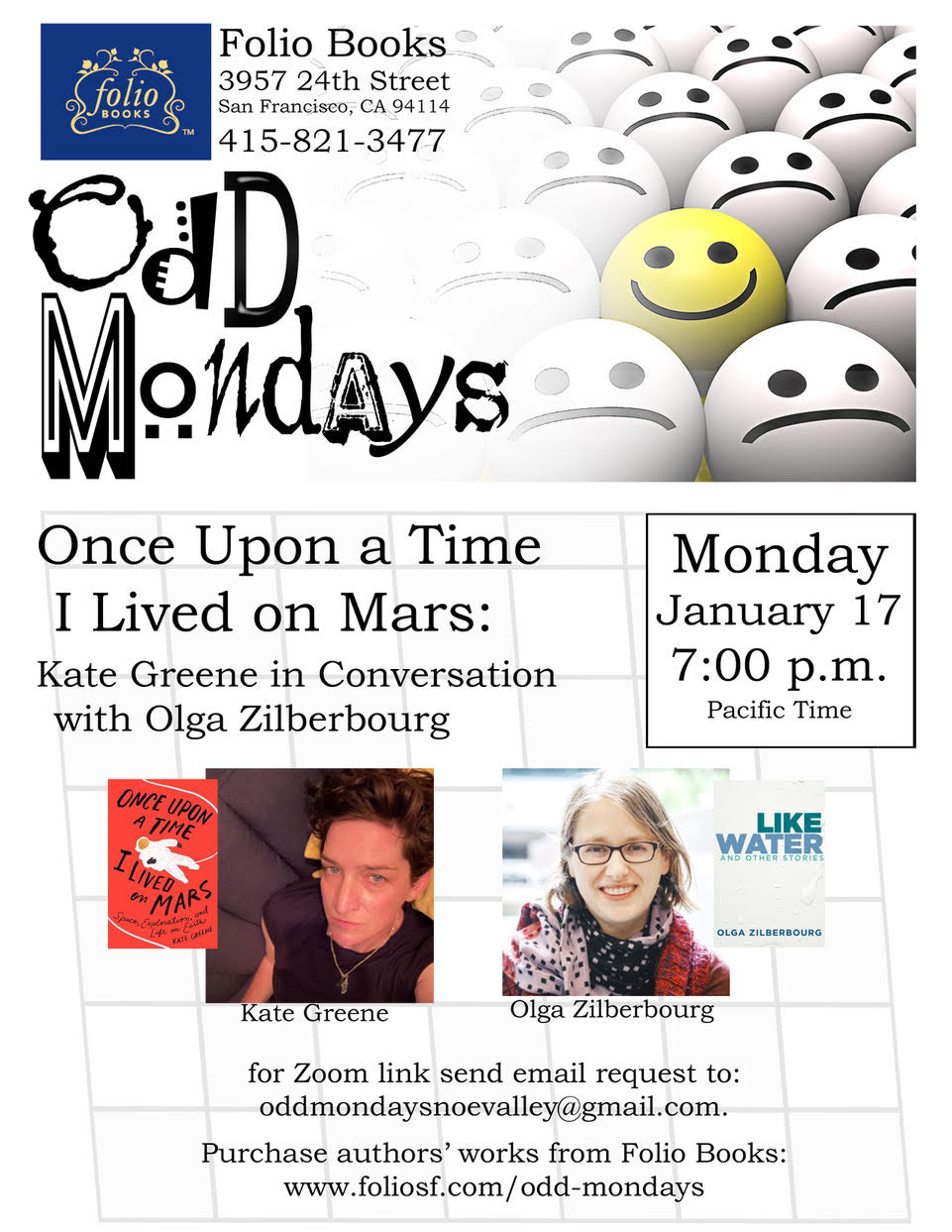
Upcoming event with Kate Greene

Here’s something to look forward to in 2022: I get a chance to do an event with journalist and poet Kate Greene about her book ONCE UPON A TIME I LIVED ON MARS — a personal story of Kate’s participation in a NASA-sponsored Mars dome experiment that dives into the history and culture of spaceflight.

Some of Kate’s biggest questions in the book explore the kinds of bodies that get to participate in space flight, pointing to how our human biases and social structures limit our quest for knowledge.

It’s an exciting, wide-book, and I hope that thanks to ZOOM many of you will be able to tune into the conversation. Huge thanks to Richard May for organizing and Folio Books San Francisco for hosting. Buy our books from Folio and register for the event here!

Review of Vesna Maric’s The President Shop

I’m happy to have written a book review for a new, to me, venue, a magazine called On the Premises, edited and published by the poet Ron Slate.

Vesna Maric emigrated to the UK in 1992, a refugee from Bosnia. A township in northern England funded her transportation. Sixteen at the time, having barely recovered from the shock of experiencing the first six months of the war, she enrolled in school where she soon recognized that “Yugoslavia had been a totalitarian state, that we had been indoctrinated, brainwashed, unfree, undemocratic” – unlike her new British neighbors who were “free of indoctrination” and democratic in practice. As she writes in an essay published in Granta, “The Fascist Within,” this information conflicted with the education she had received in Mostar where she had been a Pioneer and had been taught to regard England as a colonizing capitalist empire that teaches its citizens to value property over human life. How then to reconcile the two incompatible doctrines? What impressions of one’s world remain after we accept that the political history of any country, no matter how democratic it thinks of itself, is mainly a self-justifying lie?

https://www.ronslate.com/on-the-president-shop-a-novel-by-vesna-maric/

Please enjoy the review, and do buy the book!

The Soviet Wizard of Oz

I was delighted to participate in the BBC World Service program The Forum dedicated to L. Frank Baum and his 1900 book The Wonderful Wizard of Oz. He was deeply influenced by feminism and had a very interesting life, which makes for a great study. My contribution to the program involved talking about Alexander Volkov, who rewrote Baum’s book for the Soviet audience. Kansas in it appears far less gray and a much happier place to be than in Baum’s original, and the little dog Toto can talk.

Volkov’s novel, The Magician of Emerald City, was published in 1939, coincidentally the year of the release of the Hollywood movie based on Baum’s book. The movie and Baum’s book were completely unknown to most people behind the Iron Curtain, but the Volkov novel was hugely popular. It was foundational reading for me: one of my first chapter books, and the first book I’d read out loud in its entirety to my brother. To know more about all of this, do listen to the BBC show. Huge thanks to Bridget Kendall, the host, and to Anne Khazam, the producer of this show.

BBC World Service – The Forum, The Wizard of Oz: A homegrown American fairy tale

Here’s also the link to my earlier essay that appeared in Lit Hub: Did the Wizard of Oz Subvert Soviet Propaganda?

My Review of Akram Aylisli’s Farewell, Aylis

Here’s a new review I wrote for The Common of a remarkable book that comes to us from Azerbaijan, published thanks to the advocacy of its translator, Katherine E. Young,

Contemporary books emerging from post-Soviet countries often deal with the dehumanizing effect of the region’s systems of government on its victims, seeking to trace and partially redeem the psychological and physical harm many have suffered. For understandable reasons, few authors care to look at the perpetrators, at the people who committed murders and mass murders, informed on and denounced their neighbors. Yet, in the post-Soviet reality, often it’s these people and their descendants who have risen to the top, taken charge of the new nation states, and written their laws.

It is in this context that Akram Aylisli, in post-Soviet Azerbaijan, gathers together the three novellas and closing essay that comprise his “non-traditional novel,” Farewell, Aylis. Born in 1937, Aylisli achieved fame in the Soviet Union for his earlier trilogy People and Trees. Though pieces of this new, remarkable book have appeared in Russia, the collected Farewell, Aylis, published as a result of the efforts of his American translator, Katherine E. Young, does not yet exist in any other language.

Click here to read the rest of the review.

Review of The Consequences by Niña Weijers, trans. by Hester Velmans

I’m delighted to have this review up on The Common. It took longer to write than I had anticipated, in part, because every time I returned to this book, there was more to say about it. So many fascinating layers!

Outstanding books often have a way of catching the reader by surprise, one insight, one unexpected narrative shift at a time. Niña Weijers, a debut novelist from the Netherlands, begins her book as a character study of her protagonist, Minnie Panis. Minnie is a conceptual artist of growing international reputation, whose career has been built on acts of public self-abnegation.  With each turn of the page, Weijers extends her subject and thematic reach, keeping her protagonist in focus while exploring contemporary art, mysticism, Mayan beliefs, and early childhood development (among other themes) to enrich our understanding of Minnie’s character and the forces that govern her life.

Minnie’s story is told by an omniscient narrator who documents Minnie’s history of “disappearances”: moments of near death and of extreme out of body experiences, all of which Hester Velmans, an NEA fellowship recipient for translation, has rendered to strong effect in plain and unpretentious language. The prologue introduces us to Minnie in February, 2012 when she falls through a frozen lake in Amsterdam. This is described as a deliberate gesture—not a suicide attempt, but rather a Houdini-like disappearing act, Minnie’s third. But why such a radical performance? The ensuing narrative leads us on an investigation. . . .

Read the rest of this review here.