Meet me in Washington, DC; my parents’ novel; and more good things

I’m heading to the East Coast for a conference next week, and am using an opportunity to present my work and (re)connect with writers and readers in Washington, DC area. On December 16 at 6 pm, come to “A Literary Lagniappe,” a reading and open mic by friends of Bergstrom Books, a foreign-language books purveyor in Kensingon, MD.

This event, hosted by a nearby Kensington Row Bookshop (3786 Howard Ave, Kensington, MD), will have a Central and East European focus, and will include original work, translation, and music. As you can tell from the flyer, we’re planning to keep it festive! Please register on Eventbrite and share with friends.
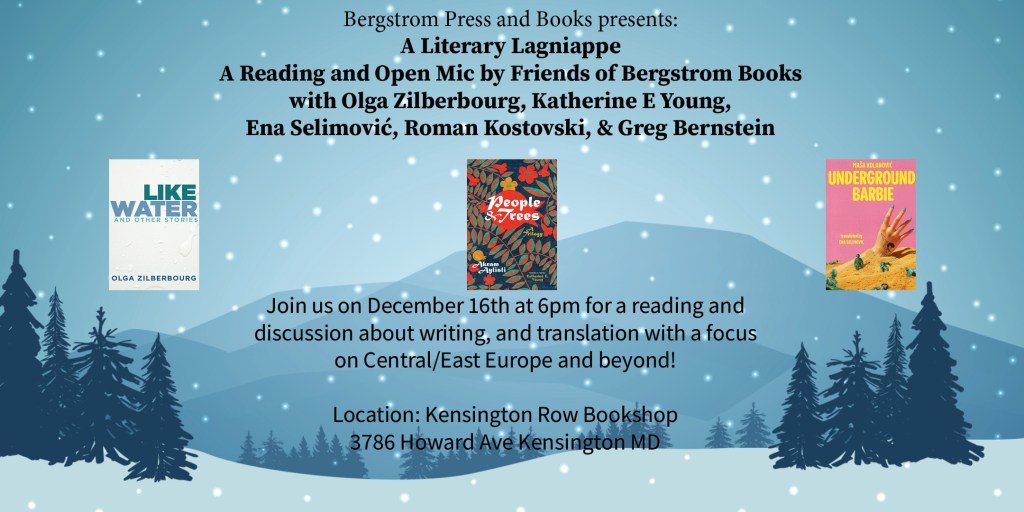
Translator and poet Katherine E. Young might read from her translations of Azerbaijani writer Akram Aylisli. Ena Selimović, Yugoslav-born translator and a co-founder of one of my favorite literary magazines, Turkoslavia, will read from Tatjana Gromača’s novella Black, newly translated. Roman Kostovski, a translator, musician, and publisher of Plamen Press, that specializes in books in translation from Central, Eastern, and Southeastern Europe (and published Aylisli’s PEOPLE AND TREES), might perform some music as well as read! Greg Bergstein, my fellow St. Petersburgian who takes inspiration from both James Joyce and Daniil Kharms might read one of his fictions.

***

In other news, check out Lina Turygina’s essay “Thinking Reeds and Foolish Weeds: On Emigration and Adaptation.” In it, Turygina (a Harvard Ph.D. student!) compares my stories with the work of Nina Berberova (!!!) –an iconic writer of the first wave of Russian emigration. “Navigating her position as a bicultural writer, Zilberbourg moves fluidly between languages, omitting details in one version, using grammar creatively in another, and always finding new ways to adapt.” My next story is going to have to feature the burdock plant — I have so many associations!

***

As some of you know, in the 60s and 70s, my dad was in a popular student rock band in Leningrad, “The Green Ants.” They performed at his university and also toured the country in the summers as a part of student work brigades.

The members of the band worked with difficult teens in Karelia, built an oil pipeline in Kazakhstan, worked on railway construction, entertained locals at a restaurant on the Kola peninsula, and at nights played rock shows, bringing Western music to Soviet audiences. They also composed their own songs and fell in love and got in trouble with authorities over set lists. Playing rock music in the USSR meant making their own electric guitars, “borrowing” amplifiers from official organizations, and creatively adapting material for approval by the censorship bureaus.

Recently, my parents started taking creative writing classes and transformed my dad’s oral stories about the band into a novel WHEN ROCK-N-ROLL WAS GREEN. The book is now available for sale in Russian–look for it wherever books are sold. And if you’re in San Francisco, come to the presentation at the Richmond Library on Sunday, January 11 at 2 pm. (In Russian language, mostly. I expect songs!)

One last good thing for today: a tiny, three-paragraph-long essay on my recent reading helped me win Jewish Book Council’s Jewish Book Month & The Bet­sy Hotel Writer’s Con­test (scroll for the essay) — and later this year, I’ll be spending a few days at the Betsy Hotel in Miami, working on my new novel.

Your Presence is Mandatory

Thank you so much to those of you who have been able to participate in my events in the past month. Lit Crawl was a huge success and I have really enjoyed introducing books of my writer friends to others in the bookish community.

I have one more event this holiday season to invite people in the Bay Area to. On Tuesday, December 9, come to The Sycamore (2140 Mission Street) to celebrate my friend Sasha Vasilyuk’s paperback release of her award-winning novel YOUR PRESENCE IS MANDATORY (such a good title — I just had to use it as the subject of this message).

This novel tells a story that’s very personal to me. Sasha based the book on her grandfather’s experience of being a Soviet Jewish prisoner of war in a Nazi camp. He managed to escape, and then had to hide the fact of his imprisonment from the Soviet authorities in order to avoid the Gulag. This secret came to bear on the rest of his life — and it’s an experience that my grandfather Isaac also shared. (I wrote about my grandfather in this essay for Narrative Magazine.)

Sasha is a great reader and organizer, and this event is bound to be great. Come if you can!

A poster with book cover in the middle and six author photos arranged in groups of three on both sides.
YOUR PRESNENCE IS MANDATORY 
Tuesday, Dec 9 at 7 pm
The Sycamore, 2140 Mission street
Paperback party
With 
Sasha and Friends
Molly Antopol
Jacqueline Doyle
Lee Kravetz
Sasha Vasilyuk
Heather Grzych
Olga Zilberbourg

In other publishing news, a story of mine called “Yes” was published in an anthology Immigrant in the City by the London Group of Multilingual Writers, led by Darya Protopopova. Stories in this book alternate between Russian and English, and include writing by my friends Maragarita Meklina and Vlada Teper, as well as work by other established and recent immigrant writers from the former USSR. Many stories address Russia’s ongoing, brutal war against Ukraine and political persecution. My contribution is an older, humorous piece about a recently divorced woman trying to be open to advances of an admirer, whose attempt to woo her with high culture (Pushkin) fails miserably.

November is for Bookish Joy — Events, Events!

Here in San Francisco, the rainy season has officially begun with the first mild and fairly warm storms of the season. Who knows what new cataclysms it might bring? As my friend Gary Pendler writes in his essay “The Bike, the Branch, and the Tick”(*), after a poplar tree branch bizarrely dropped on him in Paris, we have to be prepared that “climate change might also show up in the lives of us ordinary folk and in a myriad of day-to-day incidents.”

The best place to hide from falling branches is, to my mind, a bookstore. And, speaking of Paris, I’ve been spending a lot of time there in my imagination as I’m reading my friend Bart Schneider’s book GIACOMETTI’S LAST RIDE. Giacometti, born in Switzerland, worked in Paris, and this is where Bart’s novel is set. Bart brings to life this consummate artist, in all of his human complexities and vulnerabilities. It’s a thrilling read!

Sculpture by Leonid Sokov (1994). The Meeting of Two Sculptures: Lenin and Giacometti.

Giacometti, of course, is much beloved all across Europe and the US. But when Bart first brought pages of his manuscript to the workshop that I was a part of, I had been clueless. Bart’s chapters were my first introduction to Giacometti’s legacy. Giacometti, it turns out, was one of those modernist artists who was ideologically unacceptable to the USSR, and so censored there out of existence. The first showing of his work in Russia took place in 2007. Digging deeper, I discovered this wonderful piece above by emigre artist Leonid Sokov (1987), that showcases the clash of cultures: The Meeting of Two Sculptures: Lenin and Giacometti.

A poster with two book covers. On the top right, Bart Schneider's GIACOMETTI'S LAST RIDE, on the bottom left, Olga Zilberbourg's LIKE WATER AND OTHER STORIES. The words of the announcement read:  Bart Schneider reading from his new novel, GIACOMETTI'S LAST RIDE with writer Olga Zilberbourg.  Telegraph Hill Books, Saturday, November 8, 6:30 pm, 1501 Grant Avenue, San Francisco, CA

In many ways Giacometti’s art, showcasing the fragility of an individual, remains political in today’s world. I’m excited to be able to talk about all this and more with Bart, who will be presenting his novel on November 8, 6:30 pm, at Telegraph Hill Books in San Francisco. I hope you can come!

I’ll also be reading from a longer essay of mine “The Richest Kid in the World” (*) that dramatizes the end of censorship in the Soviet Union.

In the spirit of continuing to unpack modernity through the post-Soviet lens while building community, I am hosting two more events this November.

1) I’m absolutely thrilled that Hamid Ismailov and Shelley Fairweather-Vega will be doing an event in San Francisco for their book WE COMPUTERS, A Ghazal Novel (Yale University Press). This book is a National Book Award finalist–the first book from Central Asia to be a finalist.

Exiled from Uzbekistan (where his books are banned), Ismailov lives in the UK. He writes in at least three languages: Uzbek, Russian, and English, and Fairweather-Vega can translate him directly from Uzbek, without going through Russian. A previous novel of Ismailov’s that Fairweather-Vega translated, GAIA, QUEEN OF THE ANTS, did a fantastic job of telling contemporary stories set in the Western world, yet tying them both to immediate Soviet and post-Soviet history of Central Asia as well as to mythological history and philosophy. It offers a truly unique and fascinating perspective on the modernity–as I expect WE COMPUTERS does as well.

Come to see this stellar duo on November 9, 6 pm at The Sycamore (2140 Mission St)!!

2) On Tuesday, November 4, 4:30 pm, I’ll be introducing a feminist philosopher from the former Yugoslavia, Senka Anastasova, at Philosophers Club (824 Ulloa St).

Anastasova is a professor of aesthetics and political philosophy at the Faculty of Dramatic Arts and Humanities, at Ss. Cyril and Methodius University in Skopje. She will be introducing her Routledge Press book, POLITICAL NARRATOSOPHY: From Theory of Narration to Politics of Imagination (on Nancy Fraser, Jacques Ranciere, Paul Ricoeur).

She promises to speak on her history of “displacement, philosophy of narrating – in – the – zones – of transition, pain, dead bodies / and not – yet – dead displaced bodies, poetics of displacement and immigration, history /herstory, historiography, women’s studies and borderlands, types of exiles from one regime to another, about memory, resistance against totalitarian regimes, capital, historical materialism, freedom to choose, freedom to express today.”

This will be absolutely wild! Come.

(*) And yes, this message comes with a footnote! Gary’s essay “The Bike, the Branch, and the Tick,” and mine “The Richest Kid in the World” both appear in the same issue of the Chicago Quarterly Review. There are so many goodies there!

SF Public Library Reading and Recent Publications

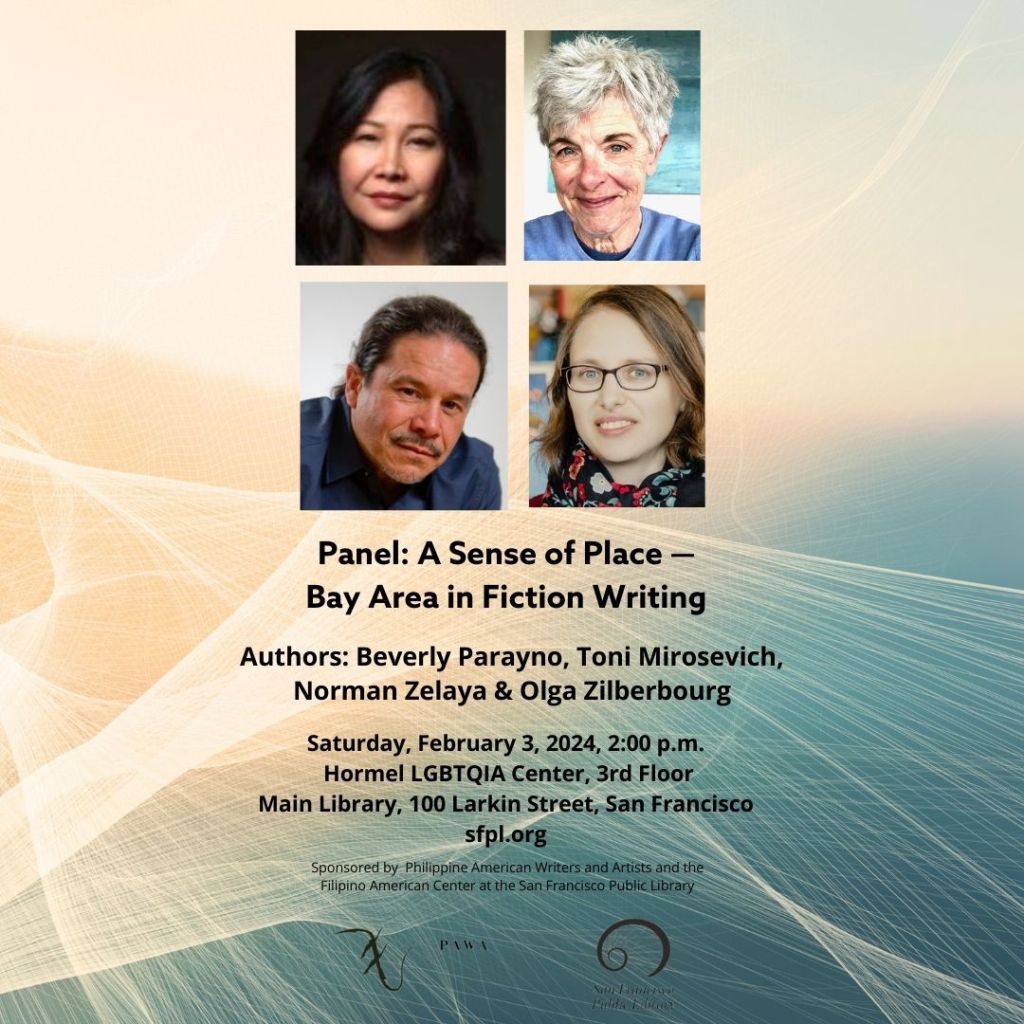
It’s still January, and so not too late, in my book, to wish you all a happy New Year. For those of you in San Francisco Bay Area, my first event of the year is coming up this Saturday, February 3. Come to the Main branch of the SF public library at 2 pm.

I will be reading an excerpt from my novel-in-progress set in Leningrad in the year 1990. This event called “A Sense of Place” is organized by my friend Beverly Parayno, whose collection of stories WILDFLOWERS it was my pleasure to blurb. I’ll be reading alongside Beverly herself, Toni Mirosevich, and Norman Zelaya. I’m delighted to meet these acclaimed writers in person and to hear their stories of the Bay Area and beyond.

In the past few months, I have published two stories. One, a brand new fiction “Make Peace with the Cake” — about an ex-Soviet immigrant parent coping with the post-COVID, war-time social tensions and her own anxieties — appears in the Museum of Americana, a magazine that has generously published 1, 2, 3 of my earlier stories.

Another piece, “Sweet Dreams,” is an older story that remains important to me for personal, creative, and political reasons. It was first published circa 2010 in an issue of Mad Hatters’ Review and has now been brought back online by the Bulb Culture Collective, a magazine that gives home to stories that first appeared in now defunct online magazines. What a noble quest! I certainly have more work to send their way.

Last but not least, the service that I have been using to send out my newsletter (TinyLetter) is being discontinued, so I’m attempting to use my website provider (WordPress) for these emails. Those of you who are already subscribing to my website may have already seen some of this information. Please let me know if you encounter any other technical issues.

Sweet Dreams

“Having reached the age of 55, my mother has decided to try out retirement. She won’t stop working—there are no opportunities for advancement in that—but she’s decided to branch out and sign up for an advanced English class after work. Her older sister is taking the same class, and my mother can’t let her sister surpass her at anything. This week, their teacher assigned them a few song lyrics to translate. My mother, determined to be an A-student, messages me for help. . . .”

Continue reading this story on Bulb Culture Collective.

It’s an older piece that was first published in Mad Hatters’ Review 12: Back from the USSR, edited by Alex Cigale and Mariya Gusev. I remain deeply grateful to the editors for taking my piece and for assembling that folio that introduced me to many fellow ex-Soviet authors I have been following ever since.

Bulb Culture Collective is a wonderful venue that gives a second life to the previously published stories and poems from online magazines that do not longer exist. I love seeing this story back online.

Make Peace with the Cake in the Museum of Americana

I’m grateful to my friends at the Museum of Americana for publishing my story, “Make Peace with the Cake” in their Food Court section. Huge thanks to Lauren Alwan for editing!

Our Leo was six or seven weeks old when we received advice from fellow Russians, as we came to call ourselves after twenty years in the US. They had two kids in elementary school and when they shared their parenting philosophy, Sioma and I listened.

“We don’t do kids birthday parties,” they said. 

Birthday parties were a giant waste of time, they said. Treated as mandatory by middle-class Bay Area parents, no matter the racial or ethnic background, these utrenniki were all alike: a bouncy house at a playground, pizza, cake. One couldn’t drop the children off but had to hang out and talk to the adults. If you couldn’t sustain a conversation about baseball scores or local politics, forget it. “Remember how it was back home?” the dad asked.

TO CONTINUE READING: https://themuseumofamericana.net/2023/11/07/americana-stories-the-food-court-fiction-2/

Introducing New Novels: Where Local Meets Global

How does one celebrate finishing a draft of a novel? Here’s my plan: I’m organizing an event with a few writers I deeply admire and whose books share some of the sensibilities that dictated my own. Transplants all, we write about the places that were important — perhaps, foundational — to us, churning memories into new stories. Please join me on August 6 for this ONLINE reading and conversation. Register on EVENTBRITE to receive the Zoom link.

Tamim Ansary’s SINKING THE ARK is set in Portland, Oregon in 1973, “Before it became Portlandia.” Barbara Barrow’s AN UNCLEAN PLACE is anchored to the campus of an experimental middle school in Atlanta, Georgia in 1992. In HOPE YOU’RE SATISFIED, Tania Malik captures Dubai during the weeks and months of uncertainty as Saddam Hussein’s army invades Kuwait in 1990, and the world awaits US response. Alicia Rouverol’s debut DRY RIVER is set in California’s suburban Mill Valley during the housing market bust of 2008. Moderator Olga Zilberbourg’s work-in-progress, DON’T SHUT THE DOOR is set in 1990 in Leningrad, USSR, just before it falls apart.

Please support writers and literature by buying books:

Tamim Ansary, SINKING THE ARK

Barbara Barrow, AN UNCLEAN PLACE

Tania Malik, HOPE YOU’RE SATISFIED

Alicia Rouverol, DRY RIVER

Olga Zilberbourg, LIKE WATER AND OTHER STORIES

Tamim Ansary is the author of The Invention of Yesterday, Destiny Disrupted, Games without Rules, West of Kabul, East of New York, among other books. For ten years he wrote a monthly column for Encarta.com, and has published essays and commentary in the San Francisco Chronicle, Salon, Alternet, TomPaine.com, Edutopia, Parade, Los Angeles Times, and elsewhere. He has appeared on the Oprah Winfrey Show, Bill Moyers, PBS The News Hour, Al Jazeera, and NPR. Born in Afghanistan in 1948, he moved to the U.S. in 1964. He lives in San Francisco.

Barbara Barrow (she/her) is the author of AN UNCLEAN PLACE (Lanternfish, 2023) and THE QUELLING (Lanternfish, 2018), which was selected as a Gold Winner for Literary Fiction in the Foreword Indies Awards. Her short stories have appeared in FAULTLINE, SOUTHERN HUMANITIES REVIEW, CIMARRON REVIEW, and elsewhere, and she also publishes literary criticism in environmental humanities, women, gender, and sexuality, and nineteenth-century literature. Originally from Atlanta, GA, she has lived in New York, Germany, St. Louis, Pittsburgh, and now Lund, Sweden, where she teaches literature and writing and lives with her husband, daughter, and pets.

Tania Malik is the author of the novels HOPE YOU ARE SATISFIED (May 2023, Unnamed Press) as well as THREE BARGAINS (W.W Norton) which received a Publishers Weekly Starred review and a Booklist Starred review.  Her work has appeared in Electric LiteratureOff-assignmentLit Hub, Salon.com, Calyx JournalBaltimore Review, and other publications. She lives in San Francisco’s Bay Area. More at www.taniamalik.com.

Alicia J Rouverol (she/her) is Lecturer in Creative Writing at the University of Salford and is the author DRY RIVER (Bridge House Publishing, 2023) and co-author of I WAS CONTENT AND NOT CONTENT’: THE STORY OF LINDA LORD AND THE CLOSING OF PENOBSCOT POULTRY (SIU Press, 2000), favourably reviewed in the New York Times and nominated for the OHA Book Award. Her stories, nonfiction and poetry have appeared in THE MANCHESTER REVIEW, THE INDEPENDENT, and STREETCAKE, among other journals. A 2008 recipient of the Elizabeth George Foundation writing grant, she received her Creative Writing MA and PhD from University of Manchester’s Centre for New Writing (2013; 2017). In 2019 she was an inaugural Artist in Residence at the John Rylands Library to develop a short story collection themed on place and migration, recently accepted by Bridge House Publishing. DRY RIVER is her first novel.

Olga Zilberbourg‘s first English-language book, a collection of short and flash fiction, LIKE WATER AND OTHER STORIES, was published by WTAW Press in 2019. It explores “bicultural identity hilariously, poignantly,” according to The Moscow Times. It also explores themes of bisexuality and parenthood. It received warm reviews from a number of publications and was named a finalist in the 2019 Foreword INDIES Book Award. Zilberbourg’s fiction and essays have appeared in Lit Hub, Electric Literature, Bare Life Review, Narrative Magazine, World Literature Today, Alaska Quarterly Review, and others. She has published four collections of stories in Russia.

Because of Roses!

San Francisco Bay Area friends! Come help me celebrate the publication of my friend Richard May’s new collection of stories, BECAUSE OF ROSES. I got to talking to Rick at a Litquake event one year, when we attended an event focused on literature in translation. I’m so impressed with the geographic and cultural range of his fiction. He writes unabashedly about love that can spark between men at every stage of life, across language barriers, ideological divides, and in the face of grief and fear. It helps that love has chance, leprechauns, and roses on its side. I delight in the magic of these stories, their kindness, and the joyful appreciation of the male bodies.

APRIL 23, 2:30 PM

MANNY’s (3092 16th St, San Francisco, CA 94103)

Rick has hosted several reading series in San Francisco, and he’s a great entertainer — I expect this to be a lot of fun with some surprises!

“Hold Your Breath Until the Future Comes” published in The Bare Life Review

I’m very happy to have a longer story of mine published in the new issue of The Bare Life Review, a magazine for immigrant and refugee writers. Issue number 4 (they are published annually) has a particular focus on climate change. I’m deeply grateful to Maria Kuznetsova for her insightful edits that helped this story to become more dynamic.

The buzzer rings. The baby must’ve felt the quake in my body. He loses the nipple and screams. I’d passed out for a few minutes, but I’m certainly awake now, and I too want to scream. Did the baby’s diaper leak on my stomach just now, or is it sweat and breastmilk pooling between us?


The air ventilation system broke in my building a few days ago. It’s June in Brooklyn, and the heat is unbearable. I nursed Anton on the couch in the living room, and my breasts are covered in liquid. He’s tired, unhappy. It feels like the two of us are bearing the brunt of the global warming, and there’s nowhere to run.

The buzzer rings again.

https://barelifereview.square.site/product/tblr-vol-4/1?cp=true&sa=true&sbp=false&q=false

The Bare Life Review is a gorgeous print publication. To continue reading, please buy the mag!

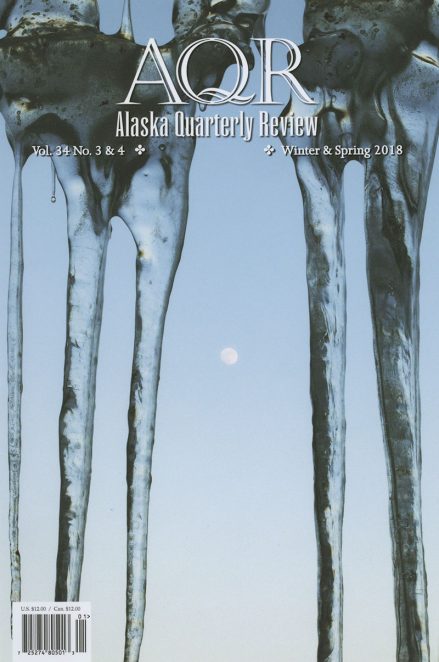
Doctor Sveta in Alaska Quarterly Review

I’m deaqr_vol34-web-439x662lighted to have a short story of mine, “Doctor Sveta,” in the current issue of Alaska Quarterly Review. Here’s the opening,

Doctor Sveta was twenty six years old when the Navy commissariat summoned her to Leningrad and put her on a cargo ship among a motley crew of agronomists, agricultural engineers, livestock breeders, and tractor drivers, none of whom knew where the ship was headed or how long the journey might take. Her fellow passengers looked as confused at finding themselves confined to a seafaring vehicle as Doctor Sveta felt. No tractors accompanied them; not a cow, not even a single chicken. The agronomists and tractor drivers were healthy young men and a few women, two of them visibly pregnant. Doctor Sveta had been trained as a surgeon in Leningrad; she assumed it was in this capacity she’d been recalled from her post at a hospital in Minsk, Belarus. Besides the ship’s medic, there were no doctors aboard and not even a basic medical facility. Doctor Sveta worried she’d have to embrace a crash course in obstetrics.

Half a century later, as she tells me this story, Doctor Sveta . . .

This is a print magazine. To read the story, please buy the issue.