Meet me in Washington, DC; my parents’ novel; and more good things

I’m heading to the East Coast for a conference next week, and am using an opportunity to present my work and (re)connect with writers and readers in Washington, DC area. On December 16 at 6 pm, come to “A Literary Lagniappe,” a reading and open mic by friends of Bergstrom Books, a foreign-language books purveyor in Kensingon, MD.

This event, hosted by a nearby Kensington Row Bookshop (3786 Howard Ave, Kensington, MD), will have a Central and East European focus, and will include original work, translation, and music. As you can tell from the flyer, we’re planning to keep it festive! Please register on Eventbrite and share with friends.
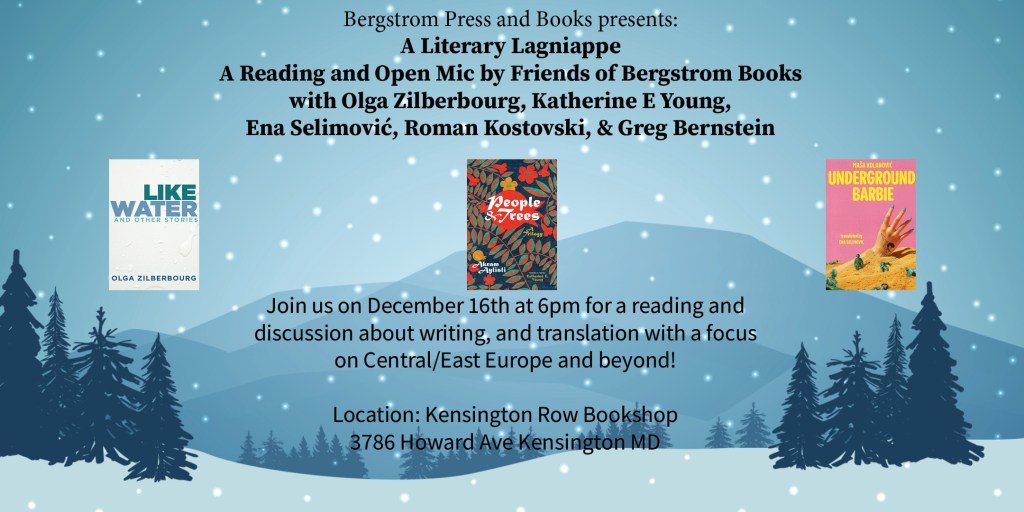
Translator and poet Katherine E. Young might read from her translations of Azerbaijani writer Akram Aylisli. Ena Selimović, Yugoslav-born translator and a co-founder of one of my favorite literary magazines, Turkoslavia, will read from Tatjana Gromača’s novella Black, newly translated. Roman Kostovski, a translator, musician, and publisher of Plamen Press, that specializes in books in translation from Central, Eastern, and Southeastern Europe (and published Aylisli’s PEOPLE AND TREES), might perform some music as well as read! Greg Bergstein, my fellow St. Petersburgian who takes inspiration from both James Joyce and Daniil Kharms might read one of his fictions.

***

In other news, check out Lina Turygina’s essay “Thinking Reeds and Foolish Weeds: On Emigration and Adaptation.” In it, Turygina (a Harvard Ph.D. student!) compares my stories with the work of Nina Berberova (!!!) –an iconic writer of the first wave of Russian emigration. “Navigating her position as a bicultural writer, Zilberbourg moves fluidly between languages, omitting details in one version, using grammar creatively in another, and always finding new ways to adapt.” My next story is going to have to feature the burdock plant — I have so many associations!

***

As some of you know, in the 60s and 70s, my dad was in a popular student rock band in Leningrad, “The Green Ants.” They performed at his university and also toured the country in the summers as a part of student work brigades.

The members of the band worked with difficult teens in Karelia, built an oil pipeline in Kazakhstan, worked on railway construction, entertained locals at a restaurant on the Kola peninsula, and at nights played rock shows, bringing Western music to Soviet audiences. They also composed their own songs and fell in love and got in trouble with authorities over set lists. Playing rock music in the USSR meant making their own electric guitars, “borrowing” amplifiers from official organizations, and creatively adapting material for approval by the censorship bureaus.

Recently, my parents started taking creative writing classes and transformed my dad’s oral stories about the band into a novel WHEN ROCK-N-ROLL WAS GREEN. The book is now available for sale in Russian–look for it wherever books are sold. And if you’re in San Francisco, come to the presentation at the Richmond Library on Sunday, January 11 at 2 pm. (In Russian language, mostly. I expect songs!)

One last good thing for today: a tiny, three-paragraph-long essay on my recent reading helped me win Jewish Book Council’s Jewish Book Month & The Bet­sy Hotel Writer’s Con­test (scroll for the essay) — and later this year, I’ll be spending a few days at the Betsy Hotel in Miami, working on my new novel.

Los Angeles, Zoom, and new publications

I’m delighted to invite you to a one of a kind event happening in Los Angeles on March 28: a reading at the Wende Museum by eighteen writers and translators from the former USSR. We’re coming together to share our work, to get to know each other, and also to eat Ukrainian food (a Ukrainian food truck is expected!) and to support Ukraine.

Register on Eventbrite and if you can’t come, please share this with your friends in LA. Irina Reyn will be there! Katya Apekina! Kristina Gorcheva-Newberry! Our star translators and poets! Did I mention eighteen readers? Each of them, a star.

Expect humor; tales and poems of sex, identity crises, parenting, cultural intersections, immigration, and war. The Wende Museum is dedicated to art and artifacts from the Cold War era, and they are currently running an exhibit called “Undercurrents II: Archives and the Making of Soviet Jewish Identity,” which aligns so closely to what many of us write about. The museum kindly agreed to stay open late for us, until 6 pm, and we’re encouraging people to get there early so that they can tour the exhibit. So: register!

For friends who can’t make it to LA, I have a Zoom event this coming Monday, March 17, 7-8 pm Pacific. Together with writers Jen Siraganian, former Poet Laureate of Los Gatos, and Christin Rice, author of The ABC’s of Pandemic Parenting (Permutation Press), we will be reflecting on the 5th anniversary of the pandemic lockdown. The lockdown has changed our lives in ways that we still feel today. I find it useful to recall the first day, week, month of it, and so I plan to read from my diary–the notes that I managed to capture in the midst of the insanity. To tune in, register here: https://us06web.zoom.us/meeting/register/M-q9F0MfRimjwisnh0uaLQ

I published two new creative pieces in the past month:

  • “Where does your motherland begin? Does it begin with a picture in a primer, with treasured friends who live down the street? With your mother’s song?”

    Radio Baltica, an Essay, about the teenage experience of growing up during my country’s collapse–it’s all about the music of the era and, of course, The Beatles. Thanks to Tint Journal based in Graz, Austria for publishing this piece. I recorded an audio track, so you can hear me reading this essay out loud. Also included is a link to a Spotify playlist where I collected most of the songs I reference. I limited myself to only one Beatles tunes, to be polite, I guess. Alla Pugacheva is here to enchant!
  • “A seven-year-old girl falls in love with a book and tells herself, I want to read every book in the world.”

    New story: “A Woman of Learning,” in Weavers Literary Review. No link here because this mag is print only for now. I have a couple of copies, so let me know if you want one — or feel free to order and support the publishers. The magazine by Moazzam Sheikh and Amna Ali focuses on South Asian American writing, and they have a very strong curatorial vision. I’m honored to have my story included, especially given that my geographies aren’t an immediate match.

I’m taking a break from book reviewing at the moment; that being said, I want to point out two book-related pieces I wrote:

  • To accompany my recent review of Avtodya Panaeva’s The Talnikov Family, I interviewed the translator Fiona Bell as well as Panaeva scholar Margarita Vaysman. To learn more about an incredible 19th century Russian female writer, a woman who helped run a most influential literary magazine, do read this Q&A: Narrating a Violent Childhood on Punctured Lines–here are so many insights!
  • I never miss a chance to gush about a favorite writer. This time, the question “what are you reading now?” from The Common arrived just as I was finishing Bohumil Hrabal’s I Served the King of England.

Introducing New Novels: Where Local Meets Global

How does one celebrate finishing a draft of a novel? Here’s my plan: I’m organizing an event with a few writers I deeply admire and whose books share some of the sensibilities that dictated my own. Transplants all, we write about the places that were important — perhaps, foundational — to us, churning memories into new stories. Please join me on August 6 for this ONLINE reading and conversation. Register on EVENTBRITE to receive the Zoom link.

Tamim Ansary’s SINKING THE ARK is set in Portland, Oregon in 1973, “Before it became Portlandia.” Barbara Barrow’s AN UNCLEAN PLACE is anchored to the campus of an experimental middle school in Atlanta, Georgia in 1992. In HOPE YOU’RE SATISFIED, Tania Malik captures Dubai during the weeks and months of uncertainty as Saddam Hussein’s army invades Kuwait in 1990, and the world awaits US response. Alicia Rouverol’s debut DRY RIVER is set in California’s suburban Mill Valley during the housing market bust of 2008. Moderator Olga Zilberbourg’s work-in-progress, DON’T SHUT THE DOOR is set in 1990 in Leningrad, USSR, just before it falls apart.

Please support writers and literature by buying books:

Tamim Ansary, SINKING THE ARK

Barbara Barrow, AN UNCLEAN PLACE

Tania Malik, HOPE YOU’RE SATISFIED

Alicia Rouverol, DRY RIVER

Olga Zilberbourg, LIKE WATER AND OTHER STORIES

Tamim Ansary is the author of The Invention of Yesterday, Destiny Disrupted, Games without Rules, West of Kabul, East of New York, among other books. For ten years he wrote a monthly column for Encarta.com, and has published essays and commentary in the San Francisco Chronicle, Salon, Alternet, TomPaine.com, Edutopia, Parade, Los Angeles Times, and elsewhere. He has appeared on the Oprah Winfrey Show, Bill Moyers, PBS The News Hour, Al Jazeera, and NPR. Born in Afghanistan in 1948, he moved to the U.S. in 1964. He lives in San Francisco.

Barbara Barrow (she/her) is the author of AN UNCLEAN PLACE (Lanternfish, 2023) and THE QUELLING (Lanternfish, 2018), which was selected as a Gold Winner for Literary Fiction in the Foreword Indies Awards. Her short stories have appeared in FAULTLINE, SOUTHERN HUMANITIES REVIEW, CIMARRON REVIEW, and elsewhere, and she also publishes literary criticism in environmental humanities, women, gender, and sexuality, and nineteenth-century literature. Originally from Atlanta, GA, she has lived in New York, Germany, St. Louis, Pittsburgh, and now Lund, Sweden, where she teaches literature and writing and lives with her husband, daughter, and pets.

Tania Malik is the author of the novels HOPE YOU ARE SATISFIED (May 2023, Unnamed Press) as well as THREE BARGAINS (W.W Norton) which received a Publishers Weekly Starred review and a Booklist Starred review.  Her work has appeared in Electric LiteratureOff-assignmentLit Hub, Salon.com, Calyx JournalBaltimore Review, and other publications. She lives in San Francisco’s Bay Area. More at www.taniamalik.com.

Alicia J Rouverol (she/her) is Lecturer in Creative Writing at the University of Salford and is the author DRY RIVER (Bridge House Publishing, 2023) and co-author of I WAS CONTENT AND NOT CONTENT’: THE STORY OF LINDA LORD AND THE CLOSING OF PENOBSCOT POULTRY (SIU Press, 2000), favourably reviewed in the New York Times and nominated for the OHA Book Award. Her stories, nonfiction and poetry have appeared in THE MANCHESTER REVIEW, THE INDEPENDENT, and STREETCAKE, among other journals. A 2008 recipient of the Elizabeth George Foundation writing grant, she received her Creative Writing MA and PhD from University of Manchester’s Centre for New Writing (2013; 2017). In 2019 she was an inaugural Artist in Residence at the John Rylands Library to develop a short story collection themed on place and migration, recently accepted by Bridge House Publishing. DRY RIVER is her first novel.

Olga Zilberbourg‘s first English-language book, a collection of short and flash fiction, LIKE WATER AND OTHER STORIES, was published by WTAW Press in 2019. It explores “bicultural identity hilariously, poignantly,” according to The Moscow Times. It also explores themes of bisexuality and parenthood. It received warm reviews from a number of publications and was named a finalist in the 2019 Foreword INDIES Book Award. Zilberbourg’s fiction and essays have appeared in Lit Hub, Electric Literature, Bare Life Review, Narrative Magazine, World Literature Today, Alaska Quarterly Review, and others. She has published four collections of stories in Russia.

Upcoming event with Kate Greene

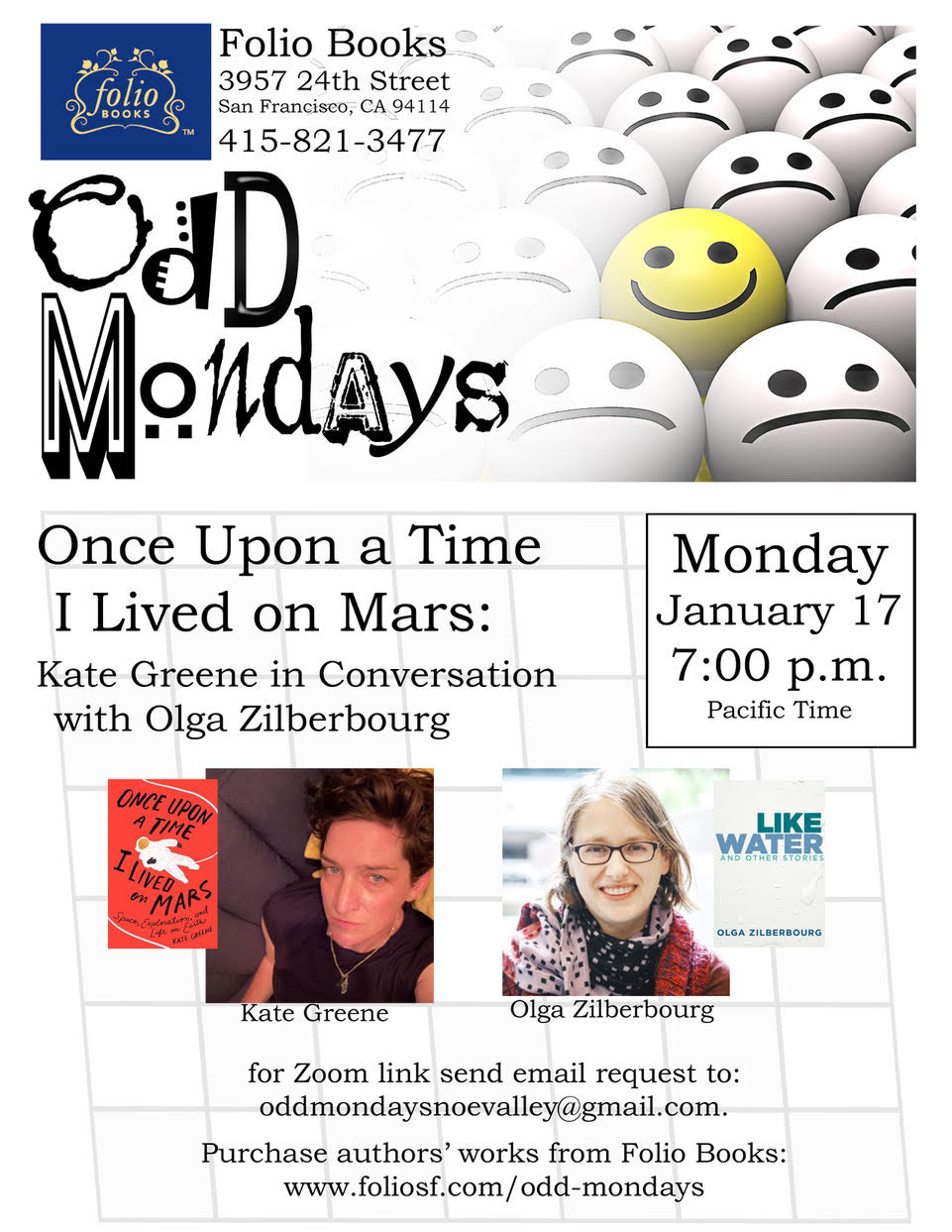
Here’s something to look forward to in 2022: I get a chance to do an event with journalist and poet Kate Greene about her book ONCE UPON A TIME I LIVED ON MARS — a personal story of Kate’s participation in a NASA-sponsored Mars dome experiment that dives into the history and culture of spaceflight.

Some of Kate’s biggest questions in the book explore the kinds of bodies that get to participate in space flight, pointing to how our human biases and social structures limit our quest for knowledge.

It’s an exciting, wide-book, and I hope that thanks to ZOOM many of you will be able to tune into the conversation. Huge thanks to Richard May for organizing and Folio Books San Francisco for hosting. Buy our books from Folio and register for the event here!

My review of Margarita Khemlin’s Klotsvog, in Lisa C. Hayden’s translation

I’m delighted to see my review of Margarita Khemlin’s powerful novel Klotsvog in Lisa C. Hayden’s translation up on The Common. Huge thanks to Nina Sudhakar for editing.

The piece is available online for free, and I urge you to spread the word, subscribe, and donate to this wonderful publication that focuses on writing of place. And they pay their writers, too!

“The year is 1950 in Kiev. A twenty-year-old college student, Maya Klotsvog, falls in love with her professor, Viktor Pavlovich. He’s eight years older and married. One day, the professor’s wife, Darina Dmitrievna, catches up with Maya at the tram stop and reveals that her husband loves Maya and has asked for a divorce. He wants to marry Maya and have children with her. But Darina Dmitrievna adds something else: “You’re Jewish and your children would be half Jewish. And you yourself know what the situation is now. You read the papers, listen to the radio. And then that shadow would fall on Viktor Pavlovich himself, too. Anything can happen. Don’t you agree? Babi Yar over there is full of half-bloods.”

https://www.thecommononline.org/review-klotsvog-by-margarita-khemlin/

Exciting new books

It just so happens that three of my friends from writing workshops are coming out with their debuts this spring. As it turns out, this spring is a very strange time to be bringing out a book into the world — coronavirus has upended most book parties and closed many bookstores. Parties are moving online in some fun, creative solutions, yet I fear that many writers and many bookstores are going to suffer for it.

All that is an aside more than a preamble to my intro of four exciting new books. I know these projects closely, from reading multiple drafts, and I cannot wait to see how they look between the covers.

The Pelton Papers by Mari Coates, is a novel from the life of Agnes Pelton, a modernist painter who died in 1961 and is only now finally finds recognition. An exhibit of her work is currently on tour around the nation, and who knows how the coronavirus will affect people’s ability to view the art. Once you read the book, though, you are going to be looking for this art in every museum out there, my promise.

Home Baked by Alia Volz. I first heard a part of this memoir ages ago, when Alia performed it at a Litquake reading. I have the image of baby Alia in a stroller as her mother pushes her down San Francisco’s Fisherman’s Wharf, peddling pot brownies that she keeps in a duffel under the stroller. She’s known as The Brownie Lady and is selling to the local business people and street acts. Later, I’ve seen several iterations of Alia’s memoir in workshop, and I can’t wait to see how the scene I fell in love with fits in with the rest.

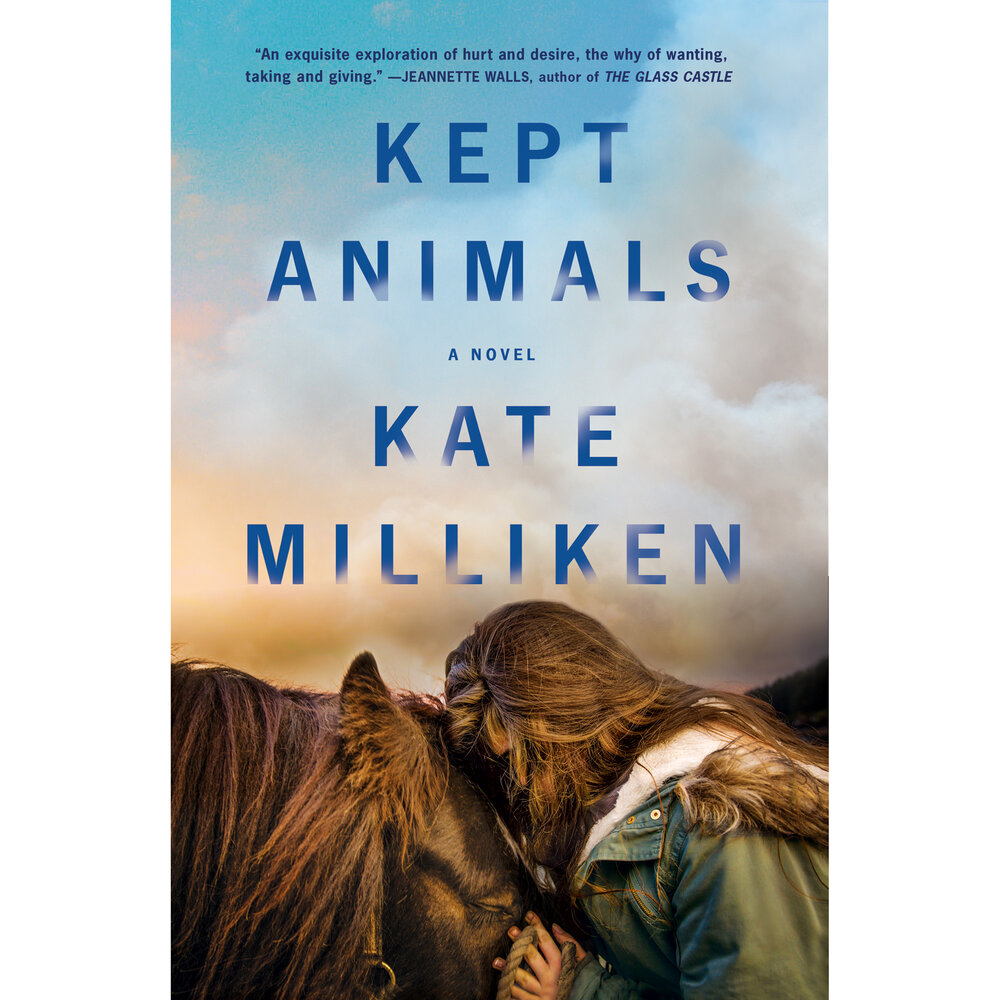
Kept Animals by Kate Milliken. In a typical workshop, people bring in about 15-20 pages of writing for participants to discuss. For novels, this can be deadly–the format completely breaks up the flow of a novel, and participants lose track of characters and story lines from one month to the next. Commenting is a challenge, because the participant really should hold most of her questions to herself. With this novel, I remember thinking, how is today’s chapter even a part of the same book? The pieces seemed to be so different from one another, and it took me a few months to start piecing it together in my mind. I’m so ready to just dive into this book.

BONUS: A few more exciting spring books by writers I admire. Please buy them and spread the word!

The Names of All the Flowers by Melissa Valentine

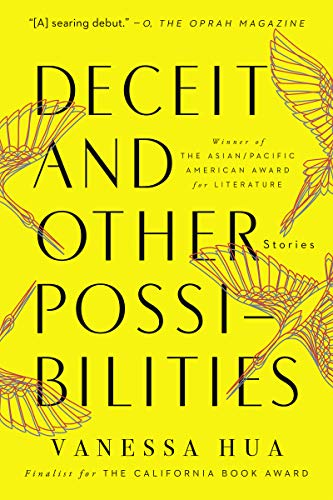
Deceit and Other Possibilities by Vanessa Hua

Three Apples Fell From the Sky by Narine Abgaryan in Lisa C. Hayden’s translation

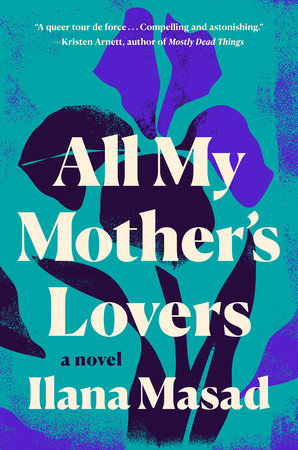
All My Mother’s Lovers by Ilana Masad

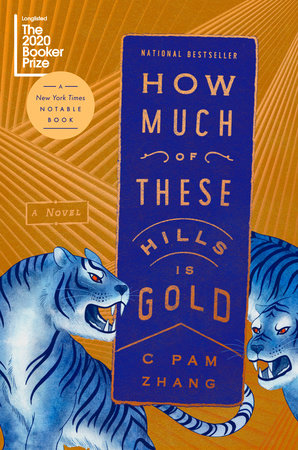
How Much of These Hills is Gold by C Pam Zhang

Eros, Unbroken by Annie Kim

* Do you have a book coming out this Spring? Please leave it in comments below, and I’ll be happy to check it out!

Like Water & Other Stories

I’m delighted to announce my first collection of stories in English, Like Water and Other Stories, will appear later this year from WTAW Press. This news is all the more gratifying because I’ve been a fan and a supporter of this press from their beginning a few years ago, and have loved every book they have put out so far. Check out their website, and here’s the announcement.

Review of The Consequences by Niña Weijers, trans. by Hester Velmans

I’m delighted to have this review up on The Common. It took longer to write than I had anticipated, in part, because every time I returned to this book, there was more to say about it. So many fascinating layers!

Outstanding books often have a way of catching the reader by surprise, one insight, one unexpected narrative shift at a time. Niña Weijers, a debut novelist from the Netherlands, begins her book as a character study of her protagonist, Minnie Panis. Minnie is a conceptual artist of growing international reputation, whose career has been built on acts of public self-abnegation.  With each turn of the page, Weijers extends her subject and thematic reach, keeping her protagonist in focus while exploring contemporary art, mysticism, Mayan beliefs, and early childhood development (among other themes) to enrich our understanding of Minnie’s character and the forces that govern her life.

Minnie’s story is told by an omniscient narrator who documents Minnie’s history of “disappearances”: moments of near death and of extreme out of body experiences, all of which Hester Velmans, an NEA fellowship recipient for translation, has rendered to strong effect in plain and unpretentious language. The prologue introduces us to Minnie in February, 2012 when she falls through a frozen lake in Amsterdam. This is described as a deliberate gesture—not a suicide attempt, but rather a Houdini-like disappearing act, Minnie’s third. But why such a radical performance? The ensuing narrative leads us on an investigation. . . .

Read the rest of this review here.


Lisa Capps and Elinor Ochs, Constructing Panic

In this pioneering books, researches Lisa Capps and Elinor Ochs look at the narrative on a woman suffering from agoraphobia and study the way she authors her narrative and the way her narrative comes to form her reality.

The linguistic shaping of sufferers’ narratives has been generally glossed over, with the result that the therapeutic effect of telling one’s life stories with another person remains largely a mystery. Psychoanalysts tend to look through narrative rather than at narrative to identify underlying emotional dynamics and formative experiences. How a teller sculpts her tale–the grammatical form and the sequencing and intertwining of pieces of setting, enigmatic experiences, and outcomes–is not a focal point but rather a medium for exposing a deeper story.

We share the view that stories can offer a powerful medium for gaining insights not fully accessible to the narrator. Indeed we endorse the perspective, held by a number of philosophers and literary critics, that narrative creates stepping stones to self-understanding. To borrow the words of Vaclav Havel, narrative allows us to confront ourselves, “to return in full seriousness to the ‘core of things,’ to pose the primordial questions again and again, and from the beginning, constantly, to examine the direction [we are] going.”

Annie Ernaux’s Shame

A powerful little book that begins with an analysis of a single episode from the writer’s past, an incident that happened when she was twelve. This book breaks so many writerly rules — in such a satisfying, rewarding way. The translation is by Tanya Leslie.

The quote is from the end of the first section.

Naturally I shall not opt for narrative, which would mean inventing reality instead of searching for it. Neither shall I content myself with merely picking out and transcribing the images I remember; I shall process them  like documents, examining them from different angles to give them meaning. In other words, I shall carry out an ethnological study of myself.

(It may not be necessary to commit such observations to paper, but I won’t be able to start writing properly until I have some idea of the shape this writing will take.)

I may have chosen to be impartial because I thought the indescribable events I witness in my twelfth year would fate away, lost in the universal context of laws and language. Or maybe I succumbed  to a mad and deadly impulse suggested by the words of a missal which I now find impossible to read, a ritual which my mind associates with some Voodoo ceremony–take this, all of you, and read it, this is my body, this is the cup of my blood, it will be shed for you and for all men.